
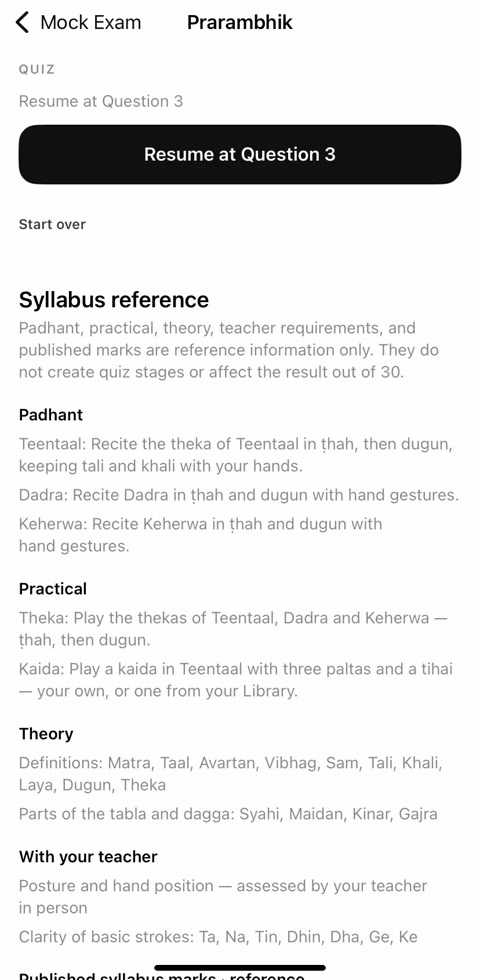
1Prarambhik
Theory
- Matra
- Taal
- Avartan
- Vibhag
- Sam
- Tali
- Khali
- Laya
- Dugun
- Theka
- Parts of the tabla and dagga
With your teacher
- Posture and hand position
- Clarity of the basic strokes
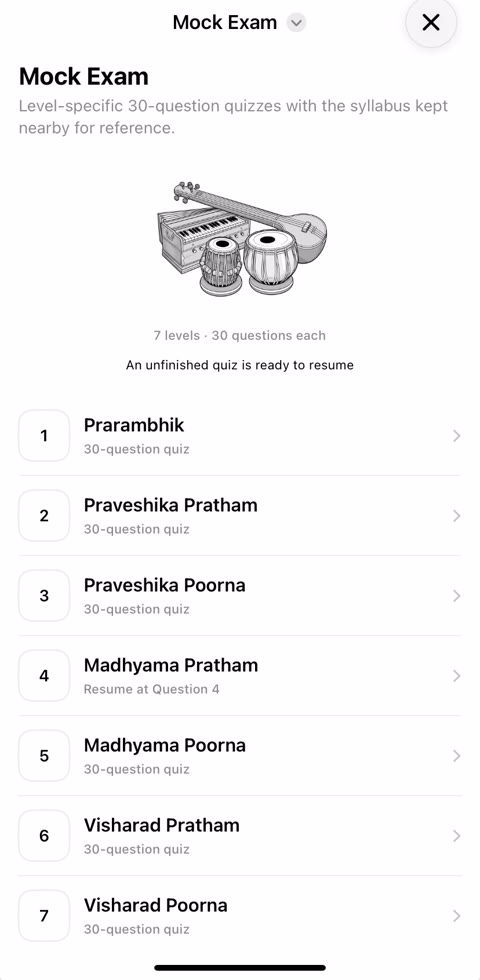
A graded tabla exam has a practical paper and a written one. Mock Exam practises the written one: thirty multiple-choice questions at your level, with the syllabus beside them.
A graded tabla exam has a practical paper and a written theory paper. Gandharva Mahavidyalaya (ABGMVM) levels run from Prarambhik through Praveshika, Madhyama and Visharad to Alankar,1 and Prayag Sangeet Samiti and Pracheen Kala Kendra use their own. Riyaz prepares the practical. Mock Exam practises the theory in thirty questions at your level, with the syllabus beside them.
Prarambhik, Praveshika, Madhyama and Visharad are ABGMVM’s level names, which the app borrows. The last three come in two parts, Pratham and Poorna, which makes seven levels.
Choosing a level opens its syllabus: padhant, practical, theory, and “With your teacher”. These lists are for reference and never become quiz stages or change your result.
The levels are the app’s own approximation. The published syllabi of the major boards, among them Prayag Sangeet Samiti and Akhil Bharatiya Gandharva Mahavidyalaya Mandal (ABGMVM), were studied and restated in the app’s own words. No board document or past paper is reproduced. Boards do not all set the same stages, or name them the same way.
ABGMVM’s tabla and pakhawaj syllabus1 runs from Prarambhik through Praveshika, Madhyama and Visharad to Alankar. The Mandal holds exams2 up to Visharad in April and May and again in November and December, and Alankar in the second session. Pracheen Kala Kendra’s examination page3 sets two years for Prarambhik, three for Bhushan, two for Visharad and two for Bhaskar. Prayag Sangeet Samiti’s instrumental music page,4 which covers tabla and pakhawaj, awards a Junior Diploma after two years, a Senior Diploma after four, Sangit Prabhakar after six and Praveen Sangeetacharya after eight. All three websites were checked on 19 November 2026.
Syllabi vary by board and year, so check your board’s current prospectus. Tabla Focus is not affiliated with, endorsed by or a partner of any examination board, including those named here, and cannot certify anyone.
Theory
With your teacher
Theory
With your teacher: nothing listed
Theory
With your teacher
Theory
With your teacher
Theory
With your teacher
Theory
With your teacher
Theory
With your teacher
Figure 1. The seven levels: theory topics and the items left to your teacher, from the app’s syllabus data. Screens are real app screens.
Each question has a first level at which it can be asked. A level-n quiz draws from levels 1 to n, and a question from level k carries weight k. An even draw would turn a Visharad paper into a beginner’s drill.
Figure 2. The target mix of a thirty-question paper at each level. If a level is short of questions, the paper fills the gap from the others.
Option order is reshuffled on every attempt.
The earlier bank was tagged to levels first by rule, from keywords in taal, form and name. If a question seems to sit at the wrong level, the fault is in its tag.
Every question must carry an explanation, so the app builds no paper from one that lacks it. The earlier bank and the generated questions are also held to two rules. A question’s text never contains one of its own options as a whole word. The wrong options are filtered so that no second reading makes one correct.
Mock Exam leaves out true-or-false statements and questions that test the app’s own wording instead of tabla knowledge.
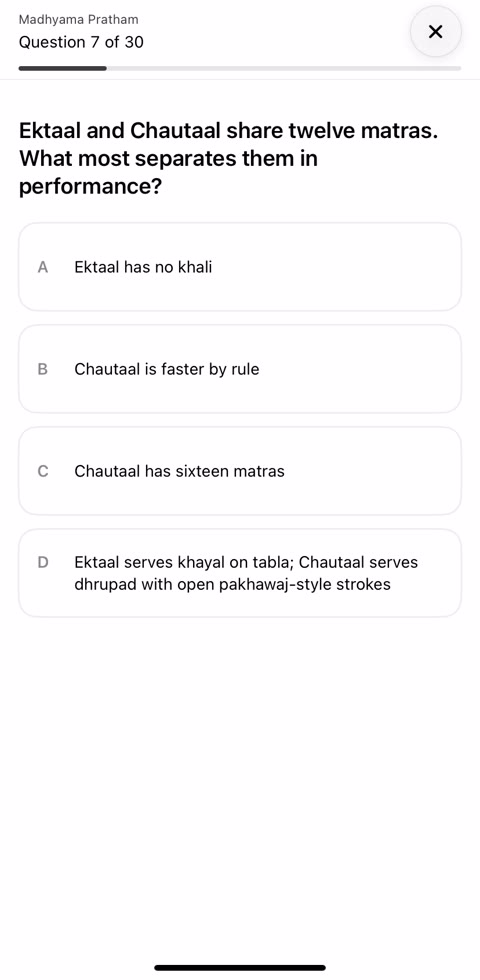
Question and options, as in the app
Ektaal and Chautaal share twelve matras. What most separates them in performance?
Figure 3. A real question. In the app the options appear in a different order each attempt, so the answer has no fixed letter.
One answer per question. It is saved on the tap.
Nothing says whether you were right.
The only number the app gives.
Your answer, the correct answer, and why.
Figure 4. One quiz, start to finish.
If you leave, the level reads “Resume at Question” and the number you reached. “Start over” discards only the unfinished quiz, while a saved result and every recording stay. Retaking draws a new paper. The level shows your latest result. Results stay on this device for your account and leave it on sign-out.
Figure 5. Mock Exam does not listen to your playing, and nothing in Tabla Focus grades or judges it.
Mock Exam is on the Explore tab with the other tools, and is part of membership.