Instrument guide

How to buy your first tabla

Find shops, makers and repairers on a world map. Compare sample prices and check both drums before you pay.

Ask your teacher first, and buy a pair you or they have heard played. On , sample prices for a full pair ran from ₹6,000 to ₹18,000 in India, €444 to €680 in Europe and US$529 to US$567 in the US. Then check both drums with the checklist below.

A good dayan gives a clear, even note at the pitch you need. A good bayan gives a clean bass note you can bend smoothly. Two tabla sets of similar playing quality can cost very different amounts. Examples checked on : 7th Chord in Delhi listed a pair at ₹6,000 for pickup, Thomann’s Portugal storefront listed a set at €444, and Musician’s Mall in Berkeley listed one at US$529. Compare what you will pay for both drums, rings, covers, a case, delivery, any import charges and the first tuning. Choose a pair your teacher recommends that fits your budget.

How much does a decent tabla cost?

On 7 November 2026, sample prices for a full pair ran from ₹6,000 to ₹18,000 in India, €444 to €680 in Europe and US$529 to US$567 in the US. Add rings, covers, a case, delivery, any import charges and the first tuning.

Which size tabla is best for a beginner?

Choose your usual Sa for accompaniment or the pitch of your practice lehra, and ask your guru if you are unsure. Then sit with the drums on their rings and check that your fingers reach the dayan’s edge and your heel rests comfortably on the bayan.

Tabla makers, shops and repairers

Browse 340 listings for tabla shops, makers and repairers across 25 countries. Search by city or shop, or zoom in and select a pin. Confirm that a directory lead still sells or repairs tabla before you visit.

Start with Shop online or Find repairs, then add your city or country to narrow the search. Confirm stock, delivery and returns with the seller.

340 places · 234 directory leadsDrag to pan. Use + / −, pinch, or Ctrl / ⌘ + scroll to zoom.
01Tabla shops, makers and repairs. Some pins mark city centres. Open a listing to find it in Google Maps. Sample prices are for both drums and were checked on . City coordinates: GeoNames.

What to check before buying

Check the pitch and response of the pair you plan to buy. If it needs work, get the repair cost before you agree to a price.

02 · Instrument reference

Anatomy of a tabla pair

Select a part to see where it sits and what it does.

Illustration of a metal bayan on the left and a wooden dayan on the right, both on blue support rings

Syahi The loading on the playing membrane. On the bayan, it usually sits off centre to leave room for heel pressure.

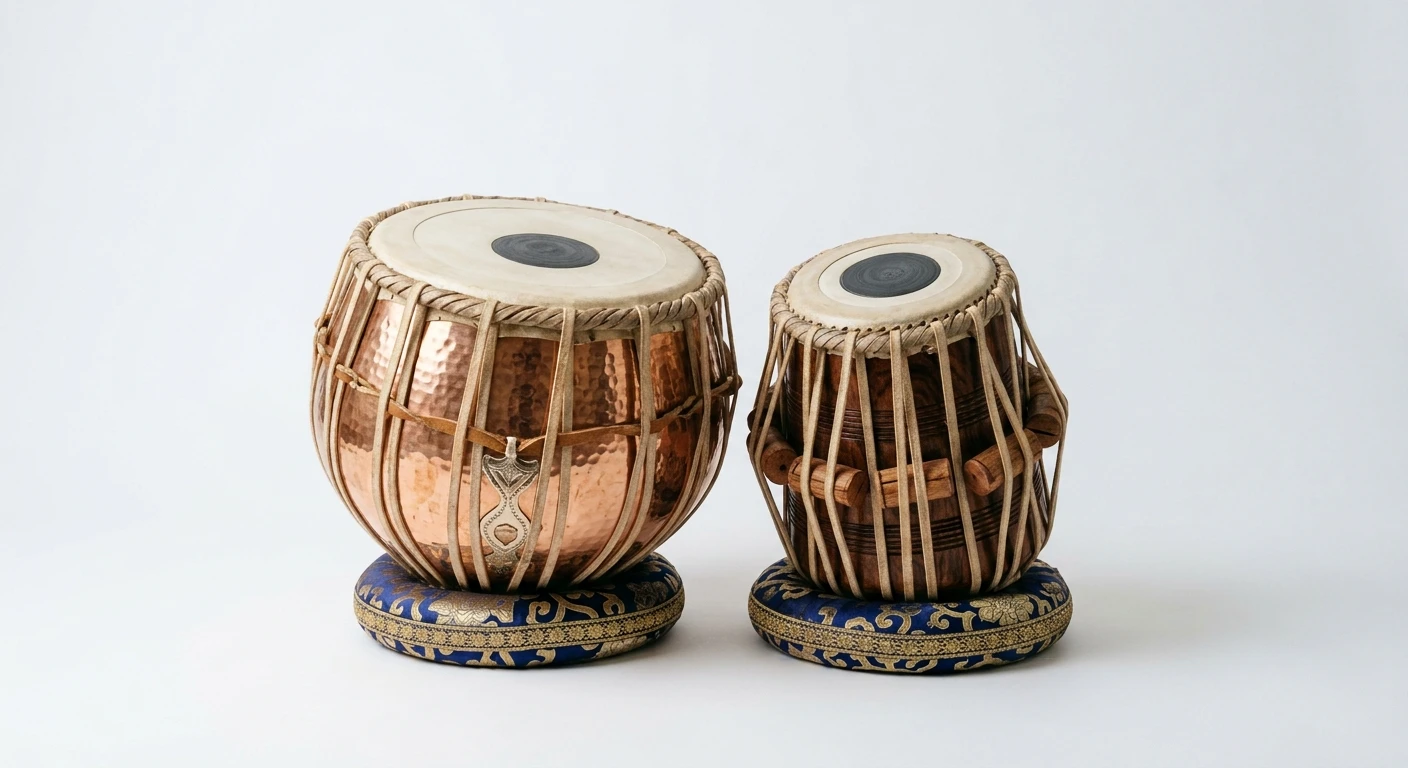
Tabla set illustration · Part names follow David Courtney’s anatomy guide.

Left · Bass drum

Bayan

The bass drum. Heel pressure on the head changes the pitch of an open ge.

Right · Treble drum

Dayan

The pitched drum. Choose a dayan that rings clearly at the Sa you need.

Tabla buying checklist

Use this before paying for a new or used pair. On a used set, check whether the repair cost changes what you would pay. For a tabla you already own, use the care and repair guide.

0 of 8 checked
  1. Step 1Choose the pitch and size
    • Choose your usual Sa for accompaniment or the pitch of your practice lehra. Ask your guru if you are unsure.
    • Ask the maker for this dayan’s comfortable tuning range. Check that it holds your target pitch without forcing it.
    • Sit with the drums on their rings. Make sure your fingers reach the dayan’s edge and your heel rests comfortably on the bayan.
  2. Step 2Inspect the pudi and syahi
    • Check each pudi (head) for tears and punctures. Look for lifting edges or missing flakes on the syahi.
    • Check that the gajra (woven rim) sits evenly around the shell.
    • A fine network of lines in the syahi can be normal. Ask a repairer to assess loose or missing material.
  3. Step 3Inspect the shells, baddhi and gatte
    • Look for cracks, splits and old repairs in the wooden shell.
    • Check the bayan’s bearing edge for distortion and the shell for sharp dents. A shallow dent matters less if the drum is stable and sounds good.
    • Check the baddhi (lacing) for cuts, fraying or weak joins. Check that the gatte (tuning blocks) sit firmly under the baddhi.
  4. Step 4Test the pair at your Sa
    • Ask the seller to tune the exact dayan to your Sa. Repeat a light na or tin at the same distance from the rim in several places. If one area stays flat or buzzes after tuning, ask the seller to correct it and play it again before you pay.
    • Play an open ge on the bayan. Repeat the stroke with a slow heel press and release. If the bass cuts out with your heel off the head, ask the seller to demonstrate the same stroke.
    • If you need two pitches, ask the maker to demonstrate both on this dayan. If it loses its ring at either pitch, try a dayan made for that pitch.
  5. Step 5Compare build and weight
    • Lift the bayan and check that it sits securely on its ring.
    • Compare the weight, thickness and sound of the actual drums.
    • Judge the playing response before paying more for a material, finish or ‘concert’ label.
  6. Step 6Confirm what comes with the pair
    • Check for two gudri (support rings), head covers, a case and a tuning hammer.
    • Check that the case supports the shells without pressing on the heads.
    • Find out who can tune the set or fit replacement heads near you.
  7. Step 7Add repair costs to a used set
    • Ask who fitted the current pudi and what work the drums have had. If the dayan still sits below your Sa with the gatte near the bottom, ask a repairer whether it needs the baddhi tightened or a new pudi.
    • If you see a shell crack, a distorted bearing edge or lifting syahi, get a repairer’s assessment before you agree to buy. Ask for a quote that includes parts, fitting and tuning.
    • Add the quote to the asking price. Compare that total with a playable pair at the pitch you need.
  8. Step 8Check delivery and returns
    • When buying online, ask for current photos and an unedited clip of the exact pair tuned to your note. Ask for strokes without backing music so you can hear the decay.
    • Confirm packing, shipping, import charges and who pays for a return. Check the terms on custom orders.
    • Inspect both drums before the return window closes. Have them tuned if needed.

Links & resources