
A tihai plays one phrase three times so that its last stroke lands on sam. If the phrase is P matras long and each gap between repeats is R matras, the tihai lasts 3P + 2R matras. A chakradar plays a whole statement ending in a tihai three times, and only the last of those tihais lands on sam.1
The math in tabla comes from how we divide the matra, group the bols and place those groups in the taal. In layakari, the bols can be grouped differently from the vibhags while the laya of the taal stays steady. The theka gives us a reference for hearing where the bols fall in the avartan.2
Martin Clayton’s Time in Indian Music treats layakari as more than a change in the number of bols per matra. He discusses how players group, repeat and reorder rhythmic phrases, and how they use repetition to bring a phrase to a close. Tomáš Reindl takes up the arrangement of phrases of different lengths in his study of Indian rhythm. In tabla solo, he discusses how recombining those phrases produces paltas within a kayda. He also describes how growing or shrinking groups enter the repertoire.23
The repertoire books show how players teach that arithmetic. As DigiTabla documents, Prem Narayan Singh’s collection of Chhotelal Misra’s mukhdas uses the same phrase to build several forms, including bedam tihai, nauhakka and farmaishi chakradar. Starting with the same bols makes it easier to see what each form changes in the count. The guide below follows that idea by showing what repeats and where the dam goes.45
How do tihais, tukras and chakradars add up?
Select a form below to see how its count works.
- P
- Palla length
- R
- Dam between pallas or layas
- M
- Opening length
- B
- Dam between complete statements
- L
- Bol count in thah
A tihai repeats one phrase thrice
Say the palla three times. In a damdar tihai you take a dam after the first and second pallas. In a bedam tihai you go straight into the next palla. If P is the length of the palla and R the length of each dam, the count is three pallas and two dams.13
3P + 2R = span
Take a tihai from sam to sam over two avartans of Teentaal. The final dha falls 32 matras after the first bol. Tabla Math shows 33 because it counts the full matra on which that dha lands.4
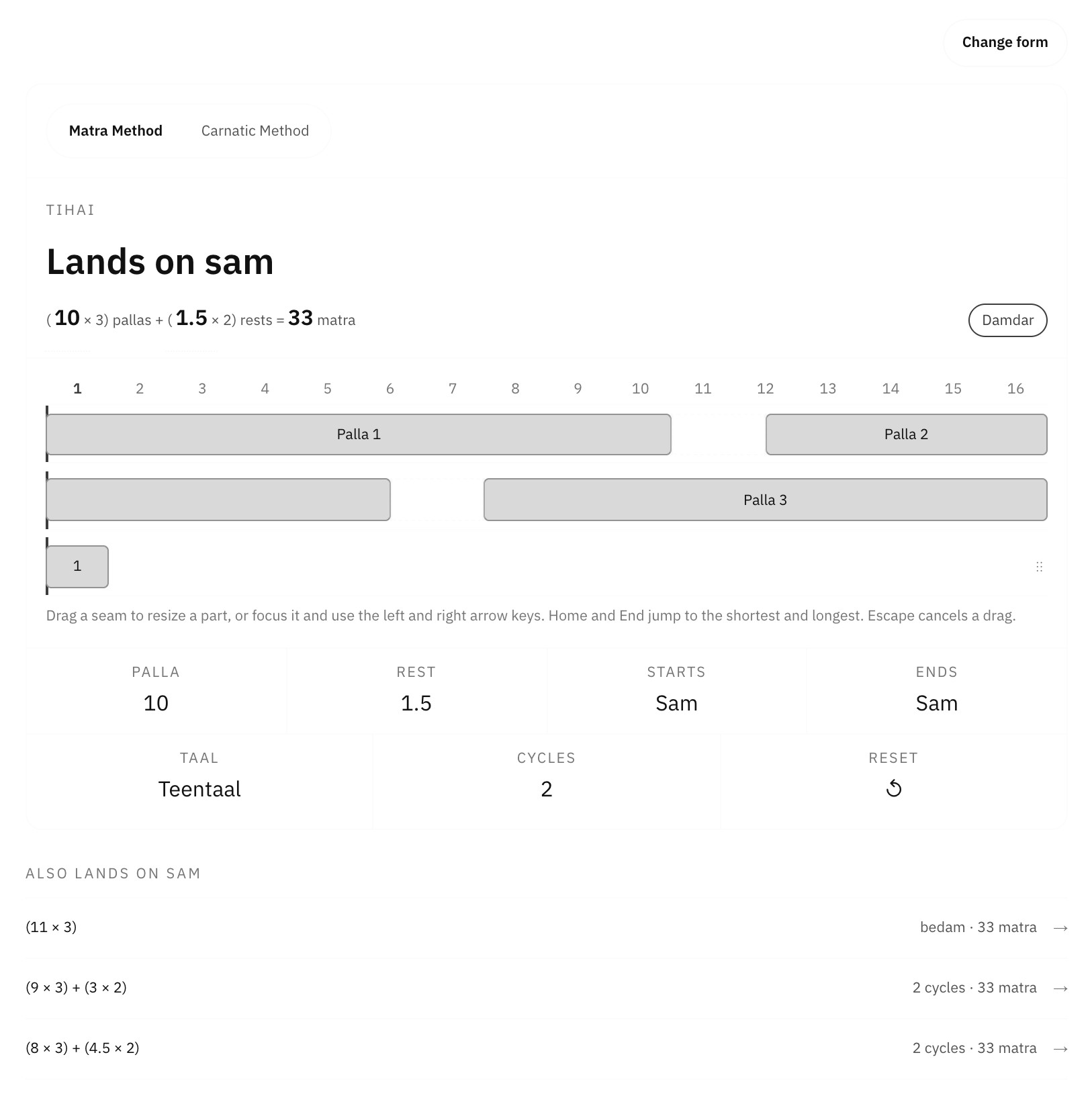
Try the 33-matra count with a 10-matra palla and a dam of 1½. The second palla comes in halfway through matra 12 of the first avartan. The third comes in on matra 8 of the second avartan, just before khali. Now take an 11-matra palla and make it bedam. The second palla comes in on matra 12 itself, and the third on matra 7. Keep clapping the taal through both. You land the final dha on the same sam, but you hear each palla enter in a different place against the theka.
A tukra gives the tihai an opening
For the tukra model, give the opening M matras and put the tihai after it. The formula becomes M + (3P + 2R). In a span of 33, an opening of eight leaves 25. Three pallas of eight and two half-matra rests fill those 25. If the opening grows by one matra, the tihai has one less matra available. Holding the eight-matra palla and removing both half-matra rests fits the new span, so you keep a phrase you already know and still make room for a longer opening.
A chakradar repeats the whole statement
Now make the opening and its inner tihai one statement, and play that statement three times. Call the rest between statements B. There are six inner rests across the composition and two outer rests. A change of half a matra in an inner palla affects all nine pallas. The same change in an outer rest affects just two places.13
3 × (M + 3P + 2R) + 2B = span
DigiTabla gives a two-cycle Teentaal example with an opening of two followed by three pallas of three. There are no rests. Each statement takes 11 matras, so three statements take 33.4
Chakradar tihai
In a chakradar tihai, the opening drops out. The dam between pallas and the dam between complete tihais are counted separately. The Studio opens this form over three cycles of Teentaal. Each inner tihai has three 5-matra pallas, so the three statements take 45 matras. Two 2-matra outer rests bring the total to 49. To hear the form, listen for the pauses that mark the larger group as well as the three phrases inside it.4
Nauhakka
The nauhakka model instead treats nine pallas as one sequence with eight equal gaps, 9P + 8R. In three cycles of Teentaal the tool fits nine 5-matra pallas and eight half-matra rests into 49 matras. If the gaps occur only between groups of three, count them as outer rests. The model with eight equal gaps then describes a different rhythm, even when you hear nine repetitions in both.4
Tipalli and chaupalli
Here the count starts with bols and their laya. An eight-bol phrase at one bol per matra takes eight matras in thah, four in dugun and two in chaugun. The Studio tipalli in Teentaal fits those three statements and two dams of 1½ into a span of 17 matras. At tigun the same phrase takes 8 ÷ 3 matras, which the whole- and half-matra grid cannot represent. The Studio chaupalli starts with six bols. Its statements take 6, 3, 2 and 1½ matras. Three dams of 1½ bring its displayed span to 17. These are sums of the full statements and dams. The last bol’s position depends on its place within the final statement.
The presets are particular laya sequences. The Benares tipalli transcribed by DigiTabla uses tigun, chaugun and chagun. Its chaupalli example uses ekgun, dugun, tigun and atgun. For a gat from your repertoire, take the laya sequence from the composition itself.6
When does the tihai formula not work?
Farmaishi
Fitting the total is one test. A farmaishi chakradar also has to place particular strokes on sam along the way. In the first statement, the first palla’s dha lands on sam. In the second, the second palla’s dha lands on sam. In the third, it is the third palla’s dha. Compare two 81-matra chakradars in Teentaal. An opening of nine and three pallas of six make a 27-matra statement. Across the three statements, the designated dhas occur at offsets 14, 47 and 80. Only the last is on sam.47
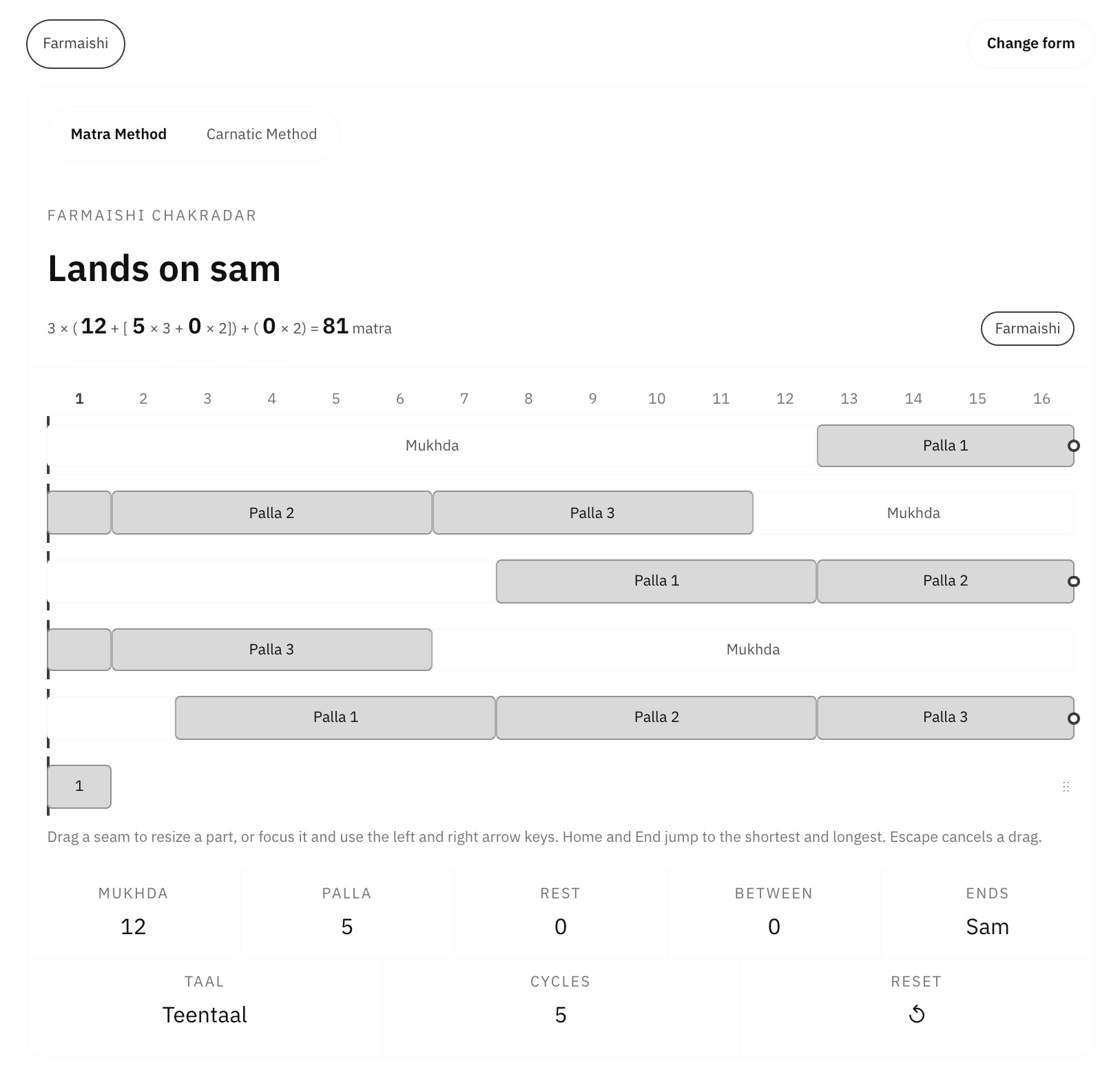
Take the Teentaal farmaishi documented by DigiTabla. It uses an opening of 12 and three 5-matra pallas in each statement, with no rests. Each statement takes 27 matras. Count from the first sam and subtract one matra from the end of the relevant palla to locate the onset of its dha. The three checkpoints are 12 + 5 − 1 = 16, 27 + 12 + 10 − 1 = 48, and 54 + 12 + 15 − 1 = 80. These are sam after one, three and five cycles.4
For a sam-to-sam farmaishi with no rests, the first checkpoint is M + P − 1. The distance between checkpoints is M + 4P because each later checkpoint advances by a statement and an extra palla. Both quantities must be multiples of the cycle length, so their difference, 3P + 1, must also be a multiple. In this five-cycle case, the first checkpoint plus two equal intervals must reach cycle five. The interval is longer than the distance from the start to the first checkpoint. The only positive whole-cycle counts that fit are one cycle to the first checkpoint, then two cycles between each pair. That gives 3P + 1 = 16 in Teentaal and 3P + 1 = 10 in Jhaptaal. The documented Jhaptaal example uses a palla of three, an opening of eight, and the checkpoints at 10, 30 and 50.7
Rests change the distance between checkpoints. Each interval adds one statement, one outer rest, one more palla and its inner rest. Subtracting the first checkpoint now gives 3P + 3R + B + 1. In Ektaal, the rest-free expression 3P + 1 cannot be a multiple of 12 on the half-matra grid. In half-matra units it is three times an integer plus two, which cannot divide evenly by 24. A five-cycle Ektaal farmaishi on the tool’s grid can instead use a 9½-matra opening, 3½-matra pallas, and a half-matra rest between statements. Each statement is 20 matras. The outer rest makes the next statement start 20½ matras later, and the extra palla makes each checkpoint 24 matras later. The dhas fall at offsets 12, 36 and 60.
A second limit comes from the counting unit. With the tool’s full-matra final dha, a one-cycle Teentaal bedam tihai would need 17 ÷ 3 matras per palla, which is outside the half-matra grid. DigiTabla shows a different count for a playable bedam example in dugun. Three pallas of 5½ matras occupy 16½ matras, with the last half-matra stroke beginning at offset 16. Both counts use the same target onset. They give the final stroke a different duration.4
Other forms in Studio
Studio presents these as reference notes in the Forms menu. A ginti tihai uses spoken numbers in place of bols and follows the tihai count. A dupalli presents the material in two layas, so its length follows from the bol count and the two laya grades.36
Mukhda and mohra are short lead-ins to sam. They can close with a tihai. An uthan opens a solo and can be fixed or improvised. Its count depends on the bols and the layas in the piece. A paran uses open pakhawaj bols and often closes with a tihai. When built as an opening plus a tihai, it follows the tukra count. In a chakradar paran, the paran forms the statement played three times.
For a kamali, follow the individual dhas inside each palla. One count described in Studio tracks 27 dhas and brings the 1st, 14th and 27th to sam. The total gives the length, while the notation tells you which dhas to check.4
The Tabla Math interface
Open Tabla Math in Focus Studio, then choose a form. Use Taal and Cycles to set the grid. In Matra Method, read the equation above the grid and follow the pallas and rests across the cycle rows. Choose a length in the equation or use the controls below the grid. The menus offer lengths the engine can fit to the current constraints. When you change one length, check the equation again to see which other parts have moved.
Move the entry. In the two-cycle Teentaal tihai, open Starts and select matra nine. Starting eight matras later leaves a span of 25. One available shape uses three 8-matra pallas and two half-matra rests. The opening portion of the grid shows the time before the player enters. Starts is available for Tihai and Nauhakka.
Move the ending. With that same start, choose an ending one matra before sam. The span becomes 24, which takes three 8-matra pallas without a rest. Choose the half-matra early ending and the span becomes 24½, where 7½-matra pallas with 1-matra rests fit. Check Ends for the positions the current form can reach. A change in ending can alter the feel of all three pallas, even when the player moves the last dha by just half a matra.
Keep all three farmaishi landings. Choose Farmaishi in Forms. The lens opens on a compatible chakradar and filters the length controls so the three checkpoints survive your edits. The ending stays on sam while the lens is active. In the five-cycle Teentaal example, find the marked dhas after the first, third and fifth cycles. Turn off the lens and set Palla to six to reproduce the 81-matra comparison above. The opening moves to nine and the final dha still lands on sam. Turn the lens back on and the tool returns to the nearest shape with all three landings.
Use the resulting lengths to annotate the bols you already play or to sketch a new phrase. Keep the taal on your hand as you recite it. If your dha lands at a different point from the grid, check the length of the last stroke, the rests and the starting matra against the notation. Tabla Math calculates lengths on a whole- and half-matra grid. For finer divisions, count the subdivisions directly from the bols.
The Carnatic Method
In Carnatic rhythm, one way to design a korvai is to work from the place where the music has to resume. The eduppu is the entry point of the reference phrase in the tala. That entry can fall at the cycle boundary or at a set offset. In their study of korvai design, Jagdish Krishnaswamy and Robert Wells set a target related to that offset, prescribe some phrase lengths, and calculate which values for the remaining lengths produce a valid result. David Nelson’s solkattu lessons give examples in the spoken and played tradition, including a korvai with its setup and a final korvai in a longer percussion sequence.89
In one of the study’s examples, Carnatic rupaka tala has 12 subdivisions per cycle and the melody enters two subdivisions after its start. If the rhythmic passage begins on that same offset, three cycles take it back to the melody’s entry in 36 subdivisions. If it starts at the cycle boundary, reaching the same entry takes 38. Three equal statements can fill 36 subdivisions. They cannot fill 38 with whole subdivisions, so the structure has to change. Choosing the landing first tells you which structures are available before you choose the phrases.9
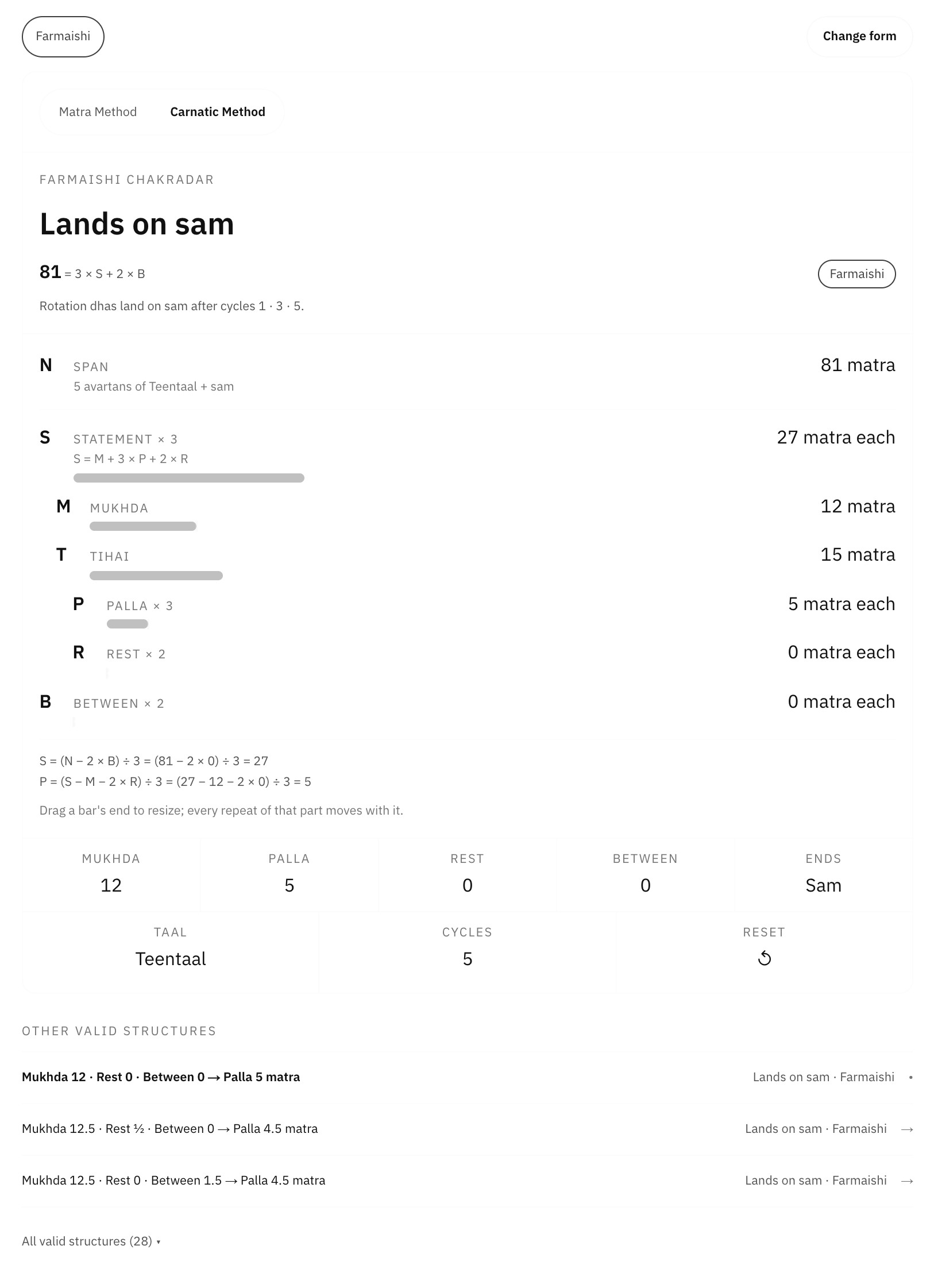
Tabla Math’s Carnatic Method applies that way of reasoning to tabla forms. It shows the same composition as a hierarchy of parts. In a tihai the parts are pallas and rests. In a chakradar, each of the three statements opens up into its opening and inner tihai, with the outer rests shown between statements. Switching methods preserves the composition. The timeline answers where the strokes sit in the cycle, while the structure view answers how the available time is distributed.
Try it with the Teentaal tihai from figure 01. Set the span to two cycles from sam to sam. If you want 1½ matras between pallas, reserve three matras for the two rests and divide what remains by three. If the palla you want is nine matras long, start with that instead. Its three statements use 27 matras, leaving six for the rests, or three each. Both choices keep the 33-matra span.
P = (33 − 2 × 1½) ÷ 3 = 10
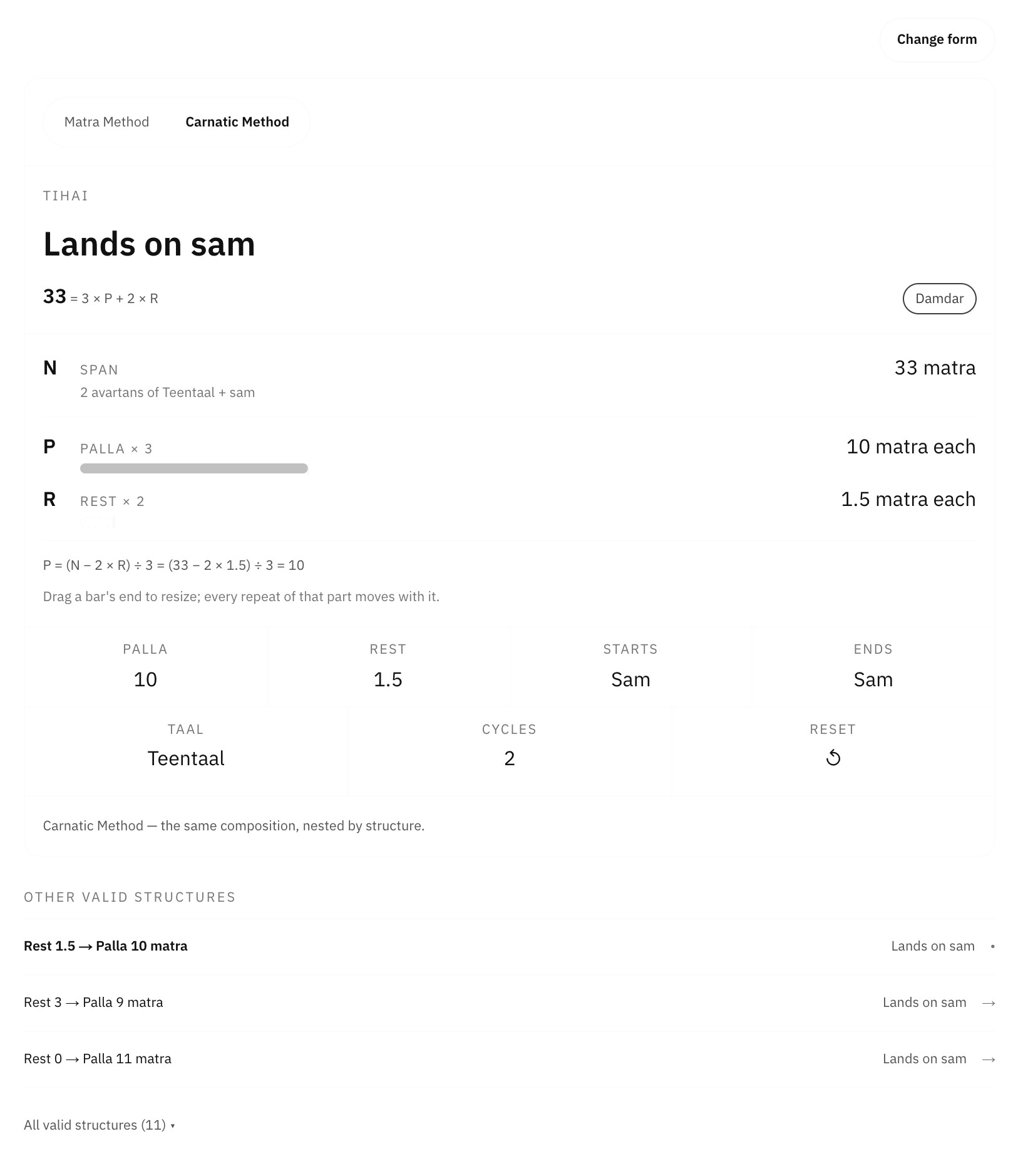
Open Other valid structures to compare alternatives for that span. A palla of 11 leaves no rest. A palla of nine leaves three matras per rest. Each additional matra in one palla consumes three matras across its repetitions, so shortening each of the two rests by 1½ compensates exactly. Choose the shape whose phrase length or pauses suit the bols you want to play. Return to Matra Method to see which matras those phrases begin on.
For a chakradar, apply the same idea in layers. Decide how much time you want between complete statements, then divide the remaining span across three statements. Inside each statement, decide how much belongs to the opening and how much to its tihai. If the farmaishi lens is active, each alternative must also pass the three checkpoint tests. A valid total narrows the options, but the individual landings decide which of those options still makes a farmaishi.
The web version in Focus Studio is free. In Tabla Focus for iPhone and iPad, Tabla Math is under Explore with a subscription.
Sources
- Gordon Thompson. “Drum Compositions.” MU 309: Music of India, Skidmore College, updated 25 April 2013. https://thompsong.domains.skidmore.edu/dept/courses/mu309/Campus/2%20North%20India/2-8%20Tabla/11-talabandis.htm. Accessed 20 November 2026.
- Martin Clayton. Time in Indian Music: Rhythm, Metre, and Form in North Indian Rāg Performance. Oxford: Oxford University Press, 2000. ISBN 9780198166863. See the chapters on taal and laya, and chapter 10 on layakari.
- Reindl, Tomáš. “Indian Rhythmic Systems as Sources of Inspiration for Western Composers.” Analytical Approaches to World Musics 11, no. 2 (2023), §§13, 21, 27–30.
- DigiTabla. “Common Tihai Forms in Tintal.” Worked counts and notation for damdar, bedam, nauhakka and chakradar forms.
- DigiTabla. “Books of Chhotelal Misra.” Includes an account of Prem Narayan Singh’s Banares Gharana ke Tabla-Vadan me Mukhra (2009).
- DigiTabla. “Gat.” Compositional forms reference.
- Swathi. “Kathak Insights – Farmaishi Compositions.” Swarna Kala Mandir, 2021. A Jhaptaal composition learned from Guru Mulla Afsar Khan.
- David P. Nelson. Solkattu Manual: An Introduction to the Rhythmic Language of South Indian Music. Middletown, CT: Wesleyan University Press, 2008.
- Krishnaswamy, Jagdish A., and Robert Wells. “A Novel Generative Paradigm for Carnatic Rhythmic Composition.” Analytical Approaches to Music of South Asia 1 (2023). See paragraphs 33–36 and 49–55 on calculating for an offset eduppu.
The Studio examples use the app’s inclusive span and half-matra grid. The cited repertoire can use other subdivisions and ways of counting the last stroke.