

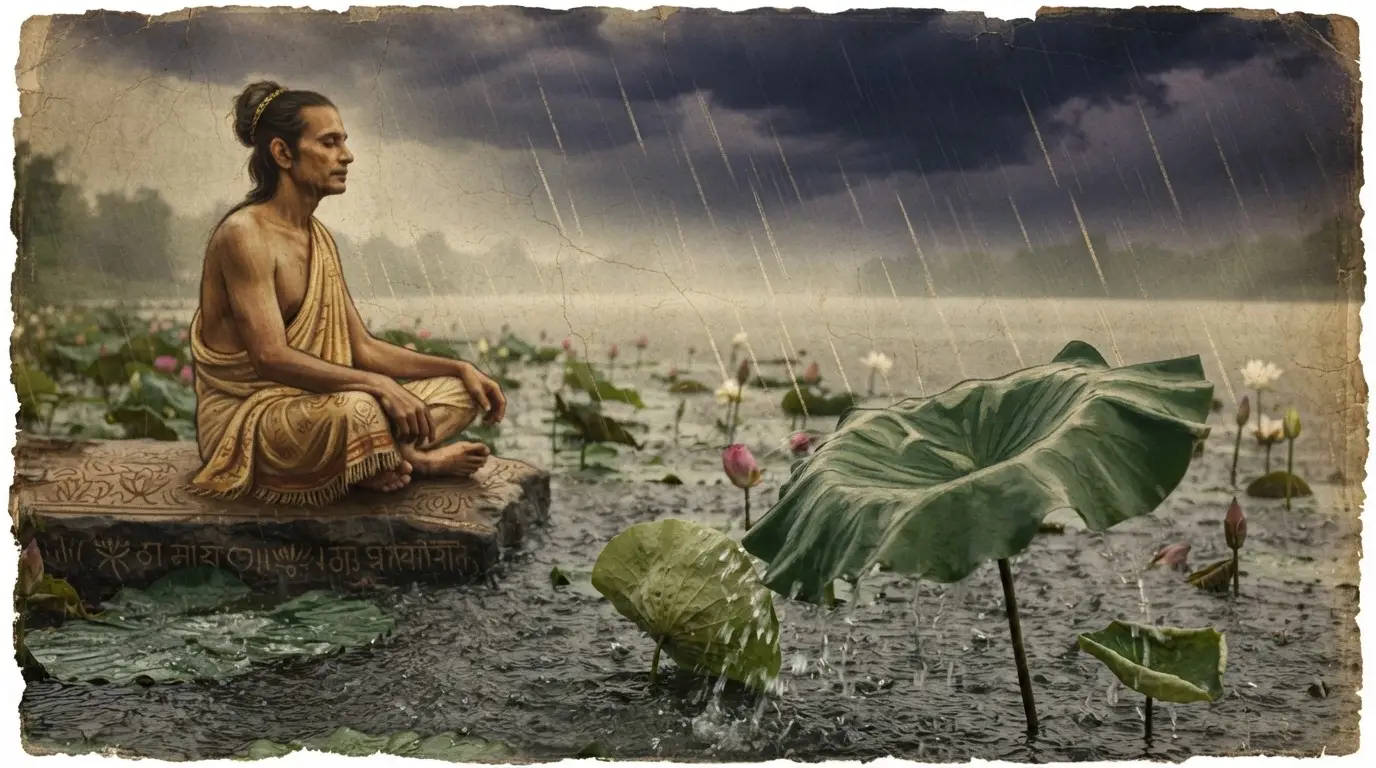
The tabla’s story begins long before the tabla itself, in the Nāṭyaśāstra, a Sanskrit book on the theatre ascribed to Bharata. Its chapters 28 to 33 are on music and instruments. The thirty-third, “On Covered Instruments”, is about drums with skin heads, and it opens by telling how the first of them were made.1 Scholars date the book to between about the second century BCE and the second century CE.23 The maker of those first drums is Svāti, a sage. One day in the rainy season, when there are no lessons, he goes to a lake to fetch water. The god Indra sends heavy rain, and the chapter goes on:
पतन्तीभिश्च धाराभिर्वायुवेगाज्जलाशये ।
पुष्करीणां पटुः शब्दः पत्राणामभवत् तदा ॥patantībhiś ca dhārābhir vāyuvegāj jalāśaye | puṣkarīṇāṃ paṭuḥ śabdaḥ patrāṇām abhavat tadā
“Then in this lake, torrents of water falling with the force of wind made clear sounds on the leaves of lotus.” (XXXIII.7)41
Svāti listens for “the high, medium and low sounds produced on the lotus-leaves” (jyeṣṭhamadhyakaniṣṭhaṃ in the Sanskrit), and finds them “deep, sweet and pleasing”. He goes home and makes drums.41 The translator thought the story might keep a memory of something that happened: it “may not be quite fanciful”.1 The chapter starts from high and low pitch before it describes a single drum.
Svāti’s drums are the mṛdaṅga family, and in particular a set of three: the āṅkika, held across the lap; the ūrdhvaka, stood upright; and the āliṅgya, held against the body. The chapter compares their shapes to a fruit, a grain and a cow’s tail:
हरीतक्याकृतिस्त्वङ्की यवमध्यस्ततोर्ध्वकः ।
आलिङ्ग्यश्चैव गोपुच्छाकृतिरेषां प्रकीर्तिताः ॥harītakyākṛtis tv aṅkī yavamadhyas tatordhvakaḥ | āliṅgyaś caiva gopucchākṛtir eṣāṃ prakīrtitāḥ
“The Aṅkī or Āṅkika is like a myrobalan[,] and the Ūrdhvaka is like a barley, and the Āliṅgya resembles a cow’s tail.” (XXXIII.243)41
Later readers have most often wanted to see the ūrdhvaka as the tabla’s ancestor, so its description matters. Ūrdhvaka means raised or upright; the dictionary gives “raised, lifted up” and, as a noun, “a kind of drum”.5 The chapter says this whole class of drums is called muraja “because they are placed in an upright position”, and when the three are consecrated the upright one is set in its own circle while the lap drum is laid crosswise.1 Nothing in the chapter says the drum’s face points at the sky. The ūrdhvaka is a barrel stood on end, wider at the middle like a grain of barley, one of a set of barrels. The chapter never connects it with anything like a tabla.
The chapter sets four rules for these drums.
Tune each skin to a svara. In the tuning called māyūrī, the peacock:
गान्धारो वामके कार्यः षड्जो दक्षिणपुष्करे ।
ऊर्ध्वके मध्यमश्चैव मायूर्यां तु स्वरा मताः ॥gāndhāro vāmake kāryaḥ ṣaḍjo dakṣiṇapuṣkare | ūrdhvake madhyamaś caiva māyūryāṃ tu svarā matāḥ
“Notes in the Māyūrī Mārjanā are Gāndhāra in the [V]āmaka, and Ṣaḍja in the Dakṣiṇa Puṣkara and Madhyama in the Ūrdh[v]aka.” (XXXIII.103; the letters in brackets correct misprints in the translation.)41
Other skin instruments, the chapter says, “produce no [distinct] notes”, and so it gives no rules for them.1
Load the skin with earth. The chapter’s word for the tuning, mārjanā, is also its word for the material put on the skin:
नदीकूलप्रदेशस्था श्यामा या मृत्तिका भवेत् ।
तोयापसरणश्लक्ष्णा तया कार्या तु मार्जना ॥nadīkūlapradeśasthā śyāmā yā mṛttikā bhavet | toyāpasaraṇaślakṣṇā tayā kāryā tu mārjanā
“The blackish earth from a river-bank, which is fine after giving out water, should be used for Mārjanā.” (XXXIII.114)41
Where there is no such earth, the next verses allow wheat flour or barley flour. The earth is prescribed for the left face and the upright drum, and the same treatment for the other two.41
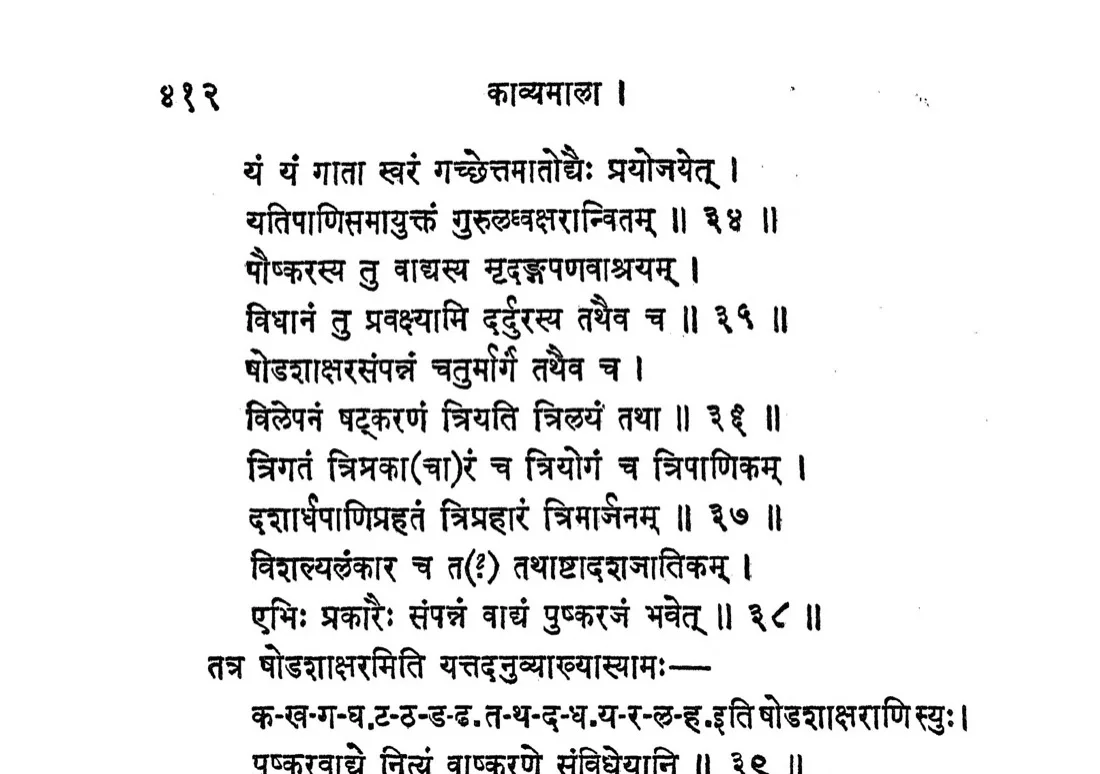
Speak the strokes as syllables. The chapter lists the syllables:
कखगघटठड[ण]तथदध[म]रलहा इति षोडशाक्षराणि स्युः ।
पुष्करवाद्ये नित्यं वाष्करणे संविधेयानि ॥ka kha ga gha ṭa ṭha ḍa [ṇa] ta tha da dha [ma] ra la hā iti ṣoḍaśākṣarāṇi syuḥ | puṣkaravādye nityaṃ vāṣkaraṇe saṃvidheyāni
Sixteen syllables, always to be used in the vāṣkaraṇa of the puṣkara drums. (XXXIII.40; the two bracketed letters are the editor’s correction.)41
The translator glosses vāṣkaraṇa as “similar in meaning to bol used by modern drummers of Northern India”.1
Give the left and right separate parts. Left and right faces are named, and so is the stroke when both are struck together:
ऊर्ध्ववामकयो[ः] समहस्तनिपाताद्धंकार[ः]
ūrdhvavāmakayoḥ samahastanipātād dhaṃkāraḥ
“By the simultaneous striking of Ūrdhvaka and Vāmaka by the two hands, there occurs haṃ.” (prose after XXXIII.42; the two bracketed marks are missing in the print.)41
In that one line a left face, two hands and a spoken name for the combined stroke all appear, much as dhā today names nā on the dāyāñ and ghe on the bāyāñ played together.
The chapter has limits as evidence. It describes one player seated among two or three barrel drums, not a pair of small upright drums, and its “left” and “right” fit the two faces of one barrel as well as two separate drums. Its syllable passages are corrupt, as the translator says, and nobody can play them today. His suggestion that vāmaka is “possibly” today’s bāyāñ and dakṣiṇa “possibly” the ḍāhinā (the dāyāñ) is his own, and he marks it as such.1 The date is a range: the translator put the text in existence by the second century of the common era, with its tradition going back to about 100 BCE, and a later scholar places it between the second century BCE and the second century CE.23 The chapter describes no tabla, but its four rules match how the tabla is tuned and played.
From mṛdaṅga to pakhāwaj
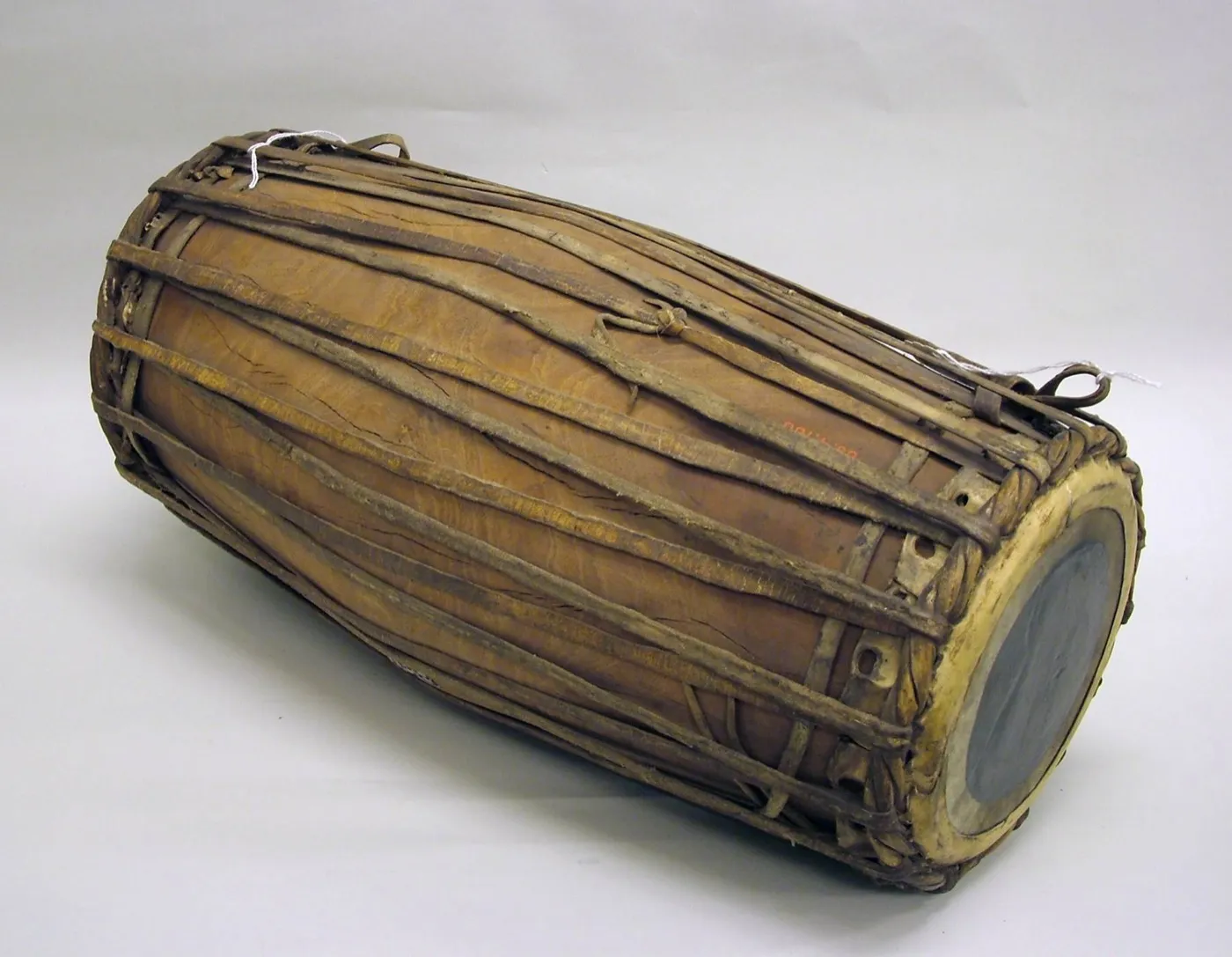
For about a thousand years after the chapter, the tuned drum in Indian sources is a barrel, played on its side or stood upright beside others.
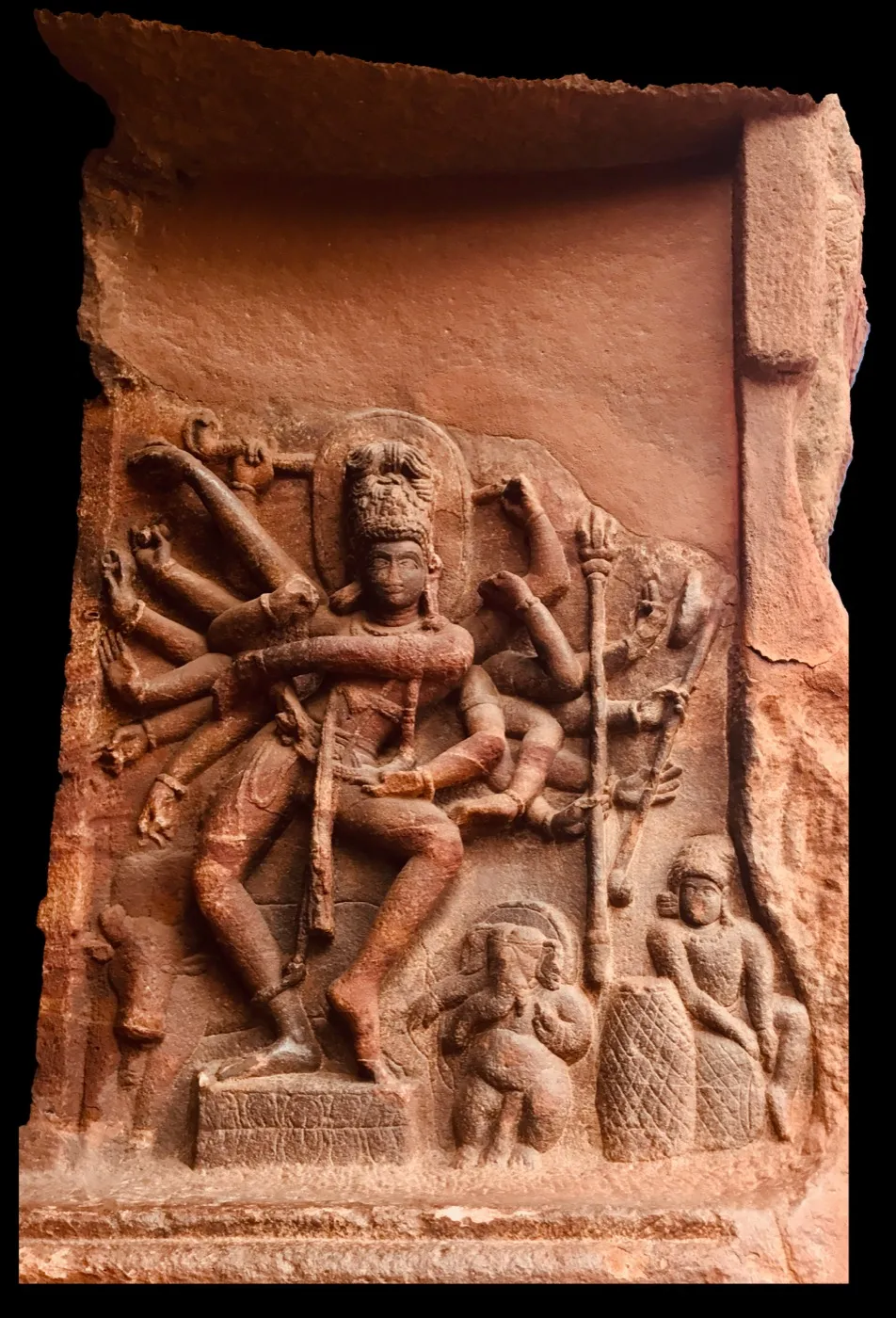
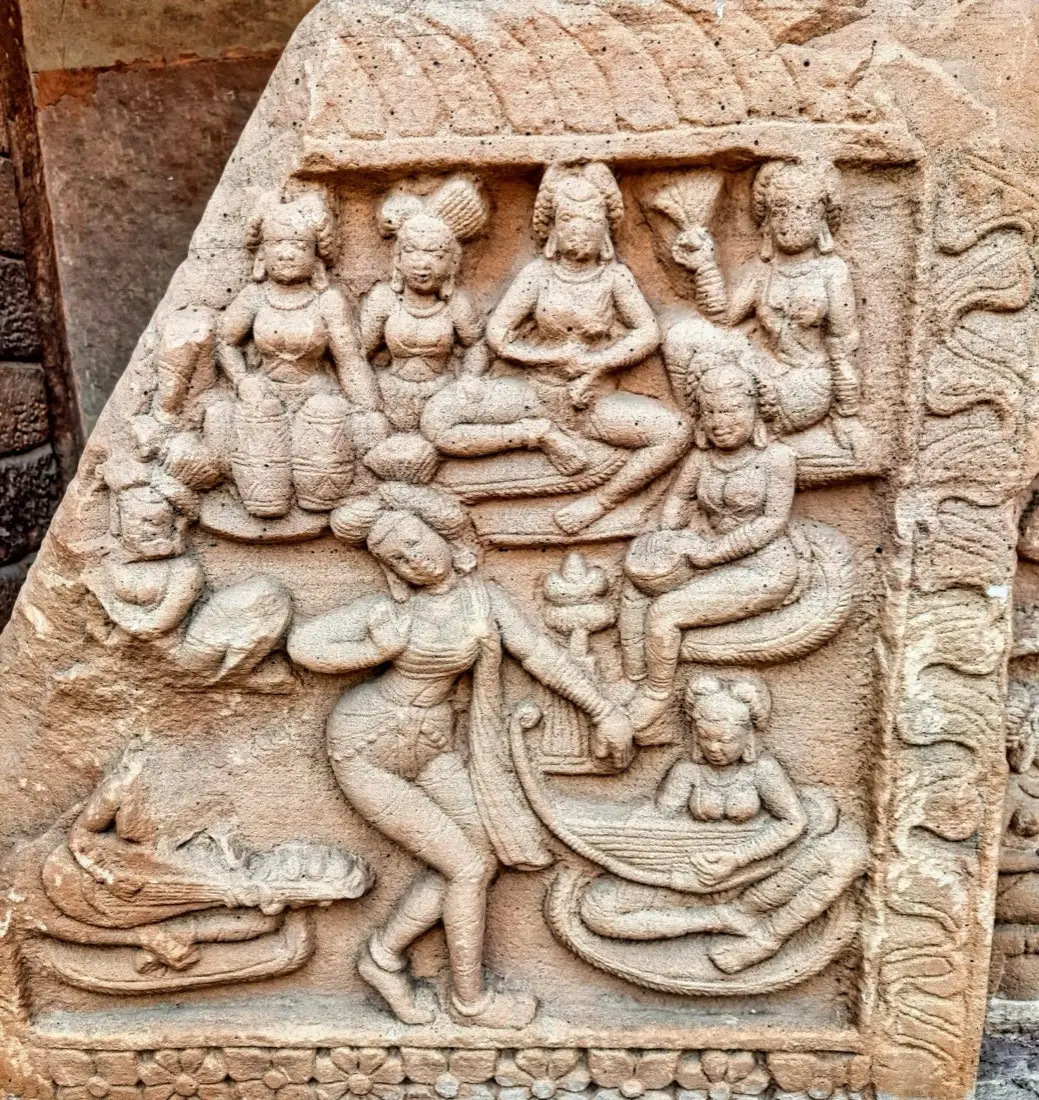
Carvings show the set often. One player with two drums appears in early Buddhist carving, and a gateway relief from Pawaya, of the Gupta period, shows a woman among the musicians seated behind two upright laced drums side by side, with what the one study of it reads as a third drum lying beside them.67 At Badami, in the sixth century, the drummer beside the dancing Śiva has one tall drum on end and another at his knee. These carvings are the usual evidence offered for an “ancient tabla”. They show upright drums, sometimes in pairs. They do not show a treble and bass pair, a syāhī or a bowl-shaped bāyāñ. The one study that goes through the early sites reads each as the Nāṭyaśāstra’s own two- or three-piece mṛdaṅga set.7 The earliest claim we have found that such carvings show a tabla is a picture book of 1955, which calls the drums in a carved window at Bhubaneswar and in a painting at Badami “tabla”.8
By about the year 1000 the commentaries have a name for the three-drum set, the tripuṣkara.9 In the thirteenth century the Saṅgītaratnākara lists twenty-three skin-covered drums, with no tabla among them. It does list a kettledrum, the niḥsāṇa, best made of bronze.10
At Akbar’s court in the 1590s the barrel drum is called the pakhāwaj, and Abu’l Fazl describes it as “made of a thick shell of wood shaped like a myrobolan and hollow”.11
Pakhāwaj players never stopped putting āṭā on the skin. The Nāṭyaśāstra’s translator, reaching the verse on flour, adds a note from his own day: “Wheat flour is still used for the Mārjanā of drums like Pākhoāj.”1 In 1914 an English writer says the same of the mridang: the plaster “is fresh made whenever the drum is used”.12 This link rests on direct statements, not inference. Pakhāwaj players still press fresh āṭā onto the left face each time they play, as the chapter’s second choice allows.
Between the chapter and the pakhāwaj there are long stretches with few dated links. What can be shown is a practice carried on in the same family of drums, under the same words. The chain has gaps, though the overlap is hard to put down to chance.
The naqqāra and the word ṭabl
Ṭabl is the ordinary Arabic word for a drum, and Platts’s dictionary of Urdu gives ṭabla as its Persian form.13 The word was in India about four centuries before the instrument. In 1350 a Jain author in western India, writing in Sanskrit, used it in a verse:
तथैव म्लेच्छवाद्यानि ढोल्लतब्लमुखानि तु ।
डफा च टामकी चैव डउंडिः पादचारिणाम् ॥“Likewise, there are the instruments of the foreigners, especially the ḍholla, and the tabla, also the ḍaphā, the ṭāmakī and the ḍauṇḍi, (played by) those who move on foot.” (4.93)14
This is the earliest dated use of the word in India that we have found. It names a drum of foreigners, played by men on foot, and says nothing about its shape, whether it came in pairs, or how it was played.
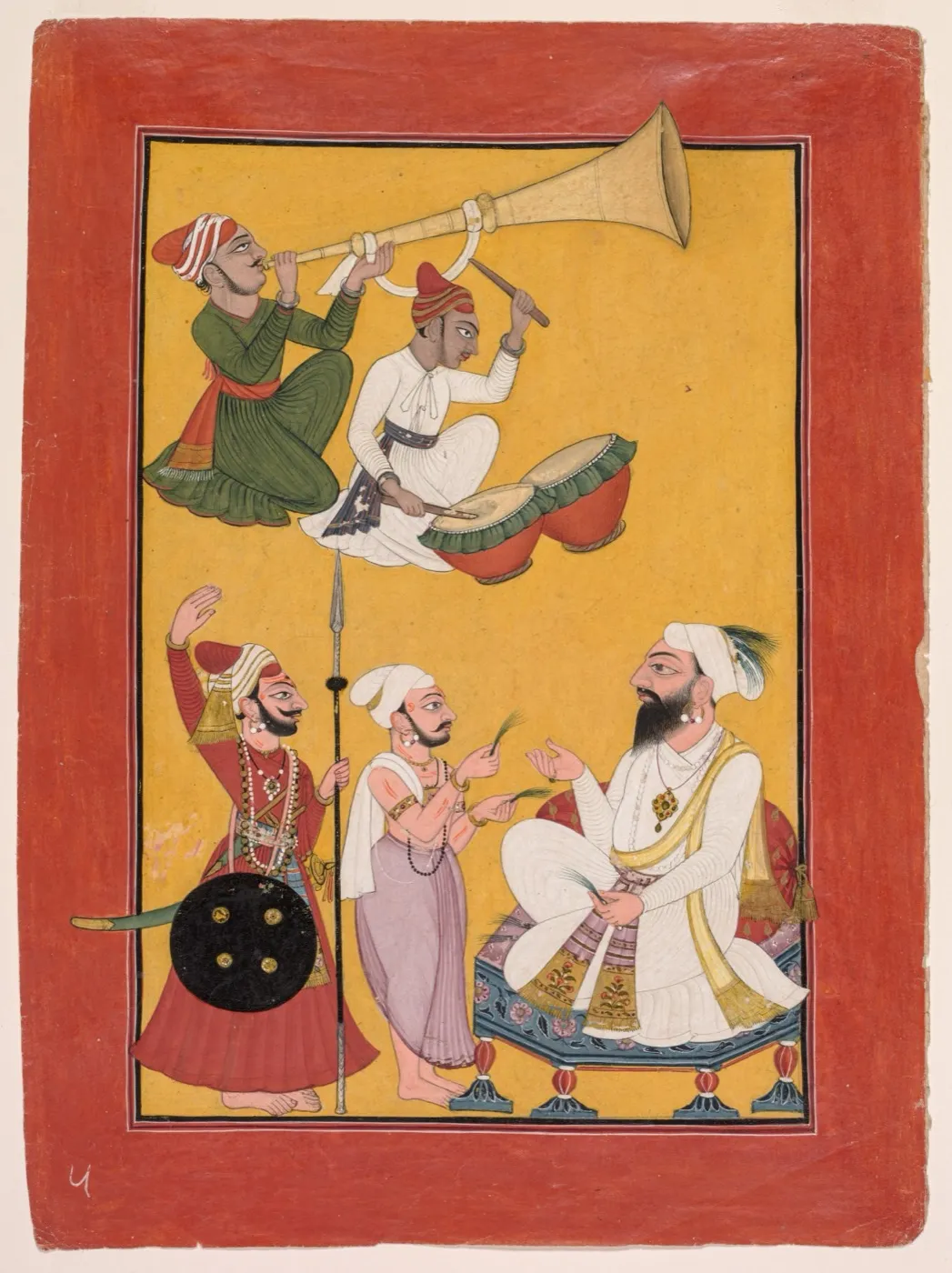
The drums that came to court with Persian and Arabic were kettledrums: bowls with a single skin, played with sticks. Akbar’s naqqāra-khāna kept about twenty pairs of naqqāra among its instruments.15 The naqqāra comes as a pair, high and low. In 1914 the smaller, higher drum is called “Zeel” and the larger “Nar”; in 1832 a small kettledrum pair is listed as zayr and bum.1617
From the naqqāra came the bowl shell, the habit of a high drum and a low drum played together, and the word. No source says it was tuned to a svara: it was played with sticks, out of doors, and no source gives it a loaded skin or spoken bols.
By 1600 both were in north India, the pakhāwaj with the singers and the naqqāra at the gate, and no source shows them played as one pair.
No tabla in the records, 1590–1750
The lists from these years are careful, and none has a tabla. The Ā’īn-i Akbarī describes the drums of Hindustan one by one, pakhāwaj, āwaj, duhul and the small ḍhaḍḍa, and names no tabla.11 A Persian treatise finished in 1698 says the general name for skin drums is mridaṅga and that they are “of fifteen kinds”, with no tabla.18 Dargah Quli Khan, who lived in Delhi from 1739 to 1741, wrote an album of the city’s musicians: it praises a pakhāwaj player and a ḍholak player by name and has no tabla player in it.19 The paintings agree. Up to about 1750 they show kettledrum pairs played with sticks, barrel drums and ḍholaks, and no pair of small drums under one player’s hands.
An absence proves little, and any one list can miss a drum. Each of these was also read in a single English translation. But they are independent of one another, they cover a century and a half, and two of them were written by people whose job was to list instruments.
Abu’l Fazl also mentions the Ḍhāḍhīs as “the Punjabi singers who play upon the Dhadda and the Kingara”.1120 When a tabla inventor is first named in print, in 1914, he is “Sudhar Khan Dhari”.16 Masters of the Delhi gharānā, interviewed in the 1980s, still called the early players Ḍhāḍhīs.21
First records of the pair, 1750–1834
The first records place the pair behind dancers. In date order:
| Date | What the source shows | Kind | How firm |
|---|---|---|---|
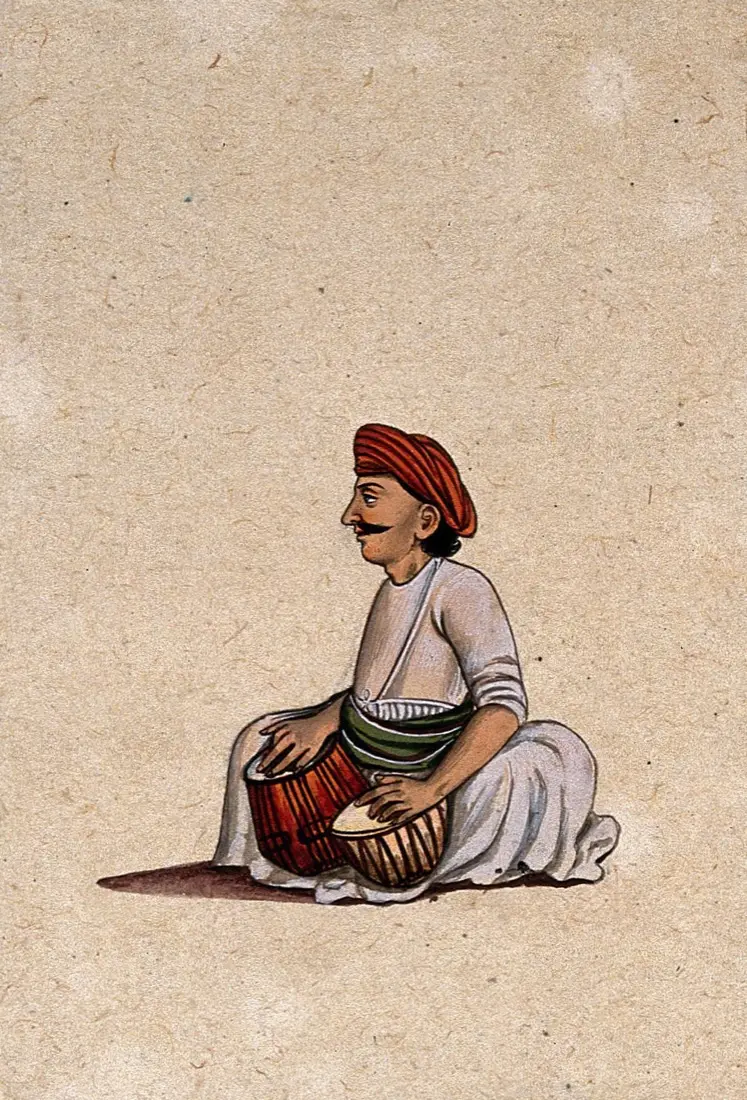
| About 1750 | Nainsukh, in the Punjab hills, paints a raja watching a dancer; behind the dancer stands a drummer with one laced drum tied at his waist | Picture | Seen. One drum, on our viewing of the museum’s image; a 1987 study captions what appears to be this painting as including “a tabla player”2220 |
| About 1762 | A sketch by the same painter: three musicians, “the nearest beating two tablas” | Picture | Known only from a description printed in 197323 |
| 1787 | “Tubla” appears under DRUM in an English and Hindustani dictionary printed at Calcutta | Text | A general word for a drum; no pair is described24 |
| 1799 | A catalogue of etchings printed at Calcutta lists plate 17: “A Tubla,—wooden Drums,” | Text and plate | Read; the plate, seen in a low-resolution online copy, shows a seated player2526 |
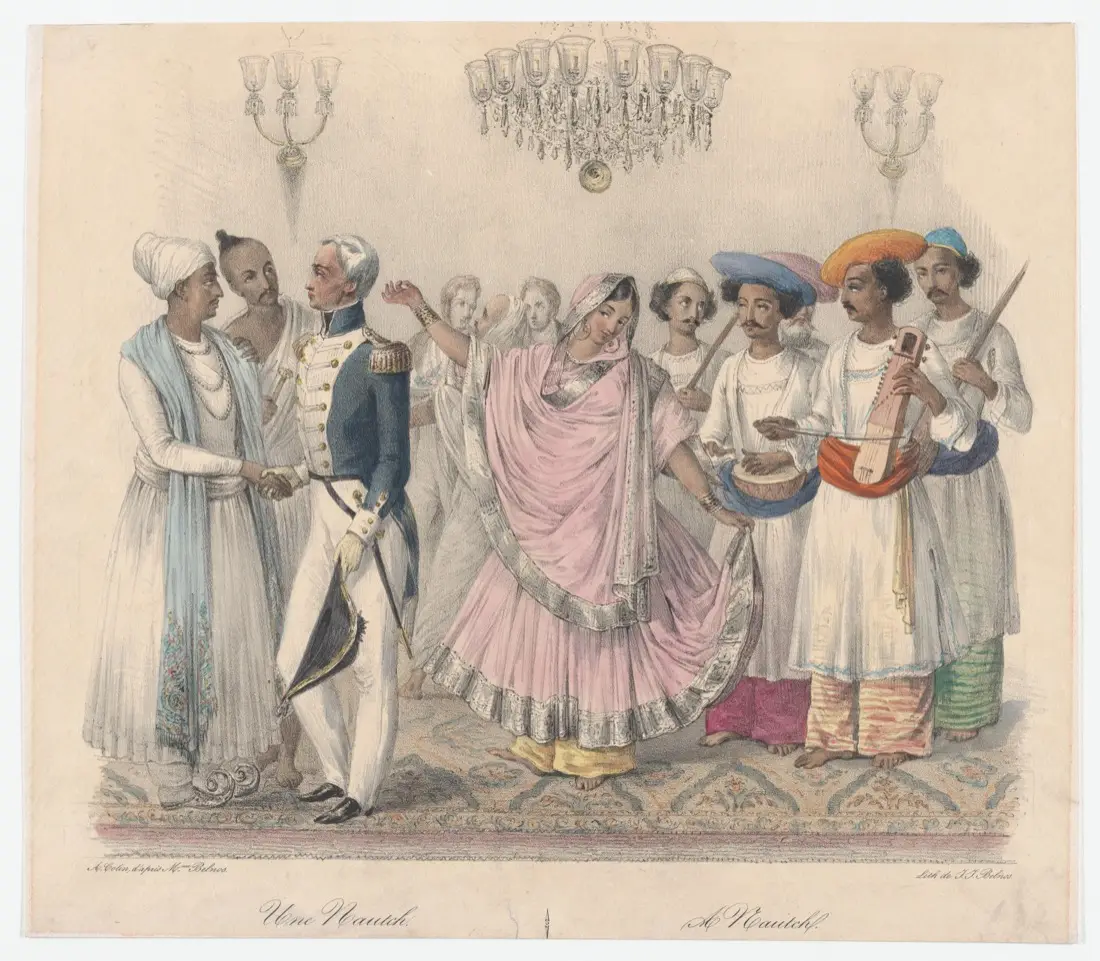
| 1809 | A British officer in a Maratha camp watches a nautch: “a man who plays upon two drums, called tubla, fixed in his girdle” | Text | Read27 |
| 1832 | “Tubla — a couple of drums, played upon at the same time, one with each hand.” | Text | Read17 |
| 1834 | The two “are always used two together, the one being the treble and the other the bass, which however may be considered as one instrument, divided from the middle for the sake of convenience.” | Text | Read28 |
None of these can safely be called the first picture of a tabla. The painting of about 1750 shows one drum. The sketch of about 1762 has been described but not reproduced anywhere we could see. The first source with both the name and a picture is the Calcutta catalogue of 1799, and the first to say in words that one man plays two drums is the letter of 1809.
The early pair was small enough to be tied at the waist in a cloth and played standing, behind a dancer; the same drums were also played seated on the floor. Within two generations it is recorded in the Punjab hills, in a Maratha camp and in Calcutta. In 1834 it was still thought new: a captain in the service of the Nawab of Banda puts it among “modern licentious inventions” and adds in his glossary: “It is of modern invention.”28
Some accounts date the tabla to 1725–1750, probably in the Punjab hills. That date comes from a doctoral thesis of 1974 that we have not been able to read; we know it only from one later scholar’s report.29 It may be right, but the documents above allow only the middle decades of the eighteenth century, with Delhi and the Punjab hills both possible.
Dāyāñ from the pakhāwaj, bāyāñ from the naqqāra
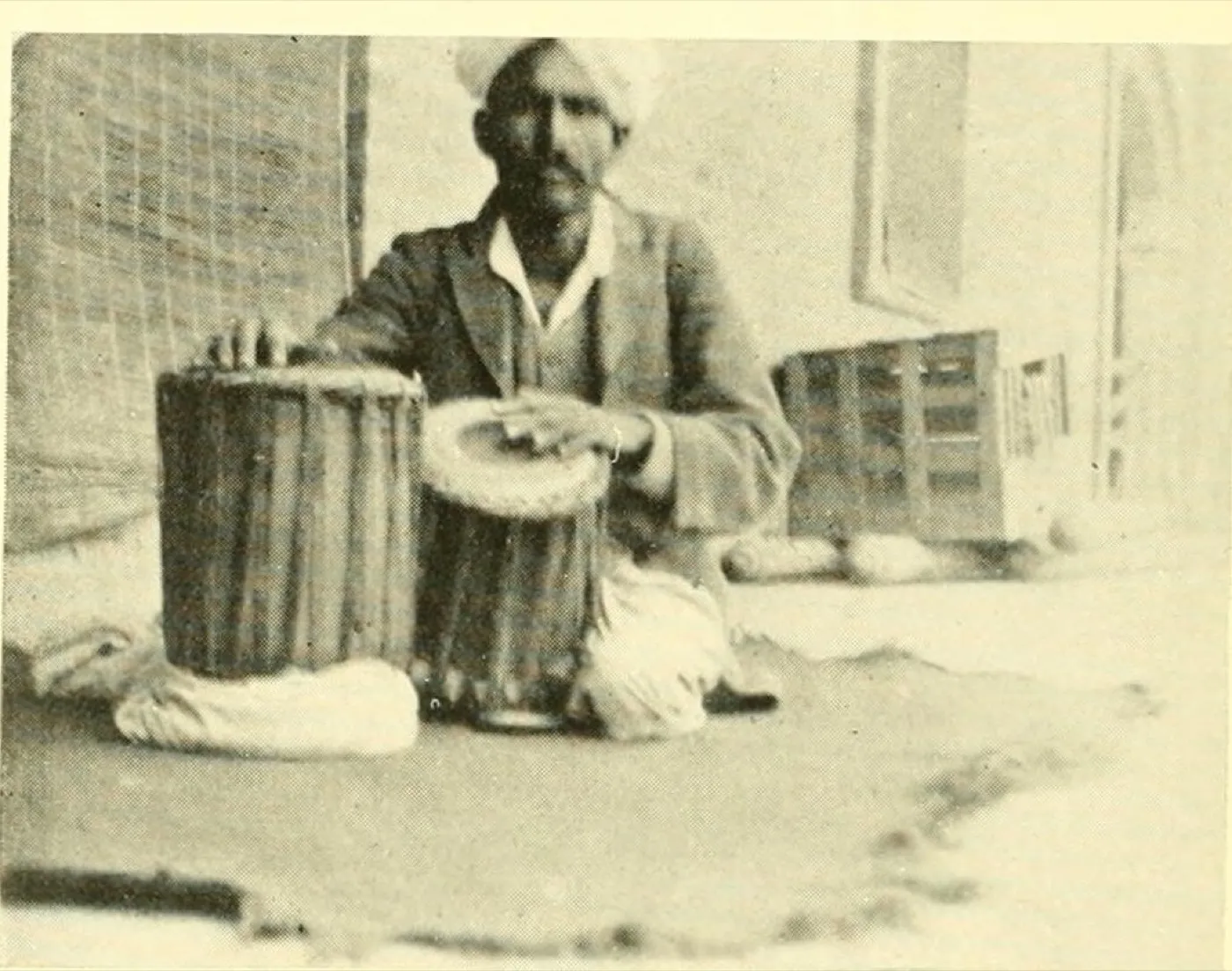
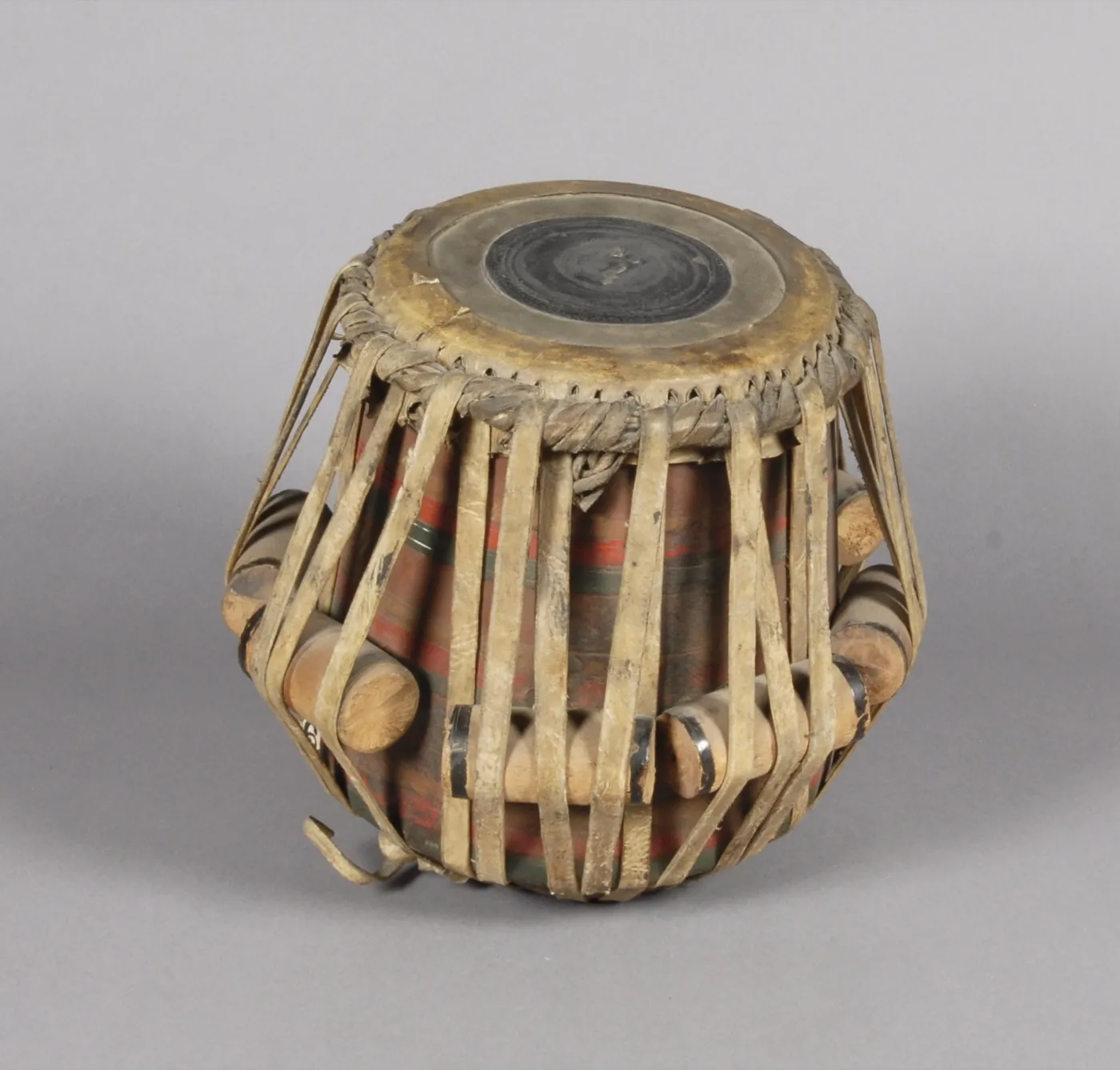
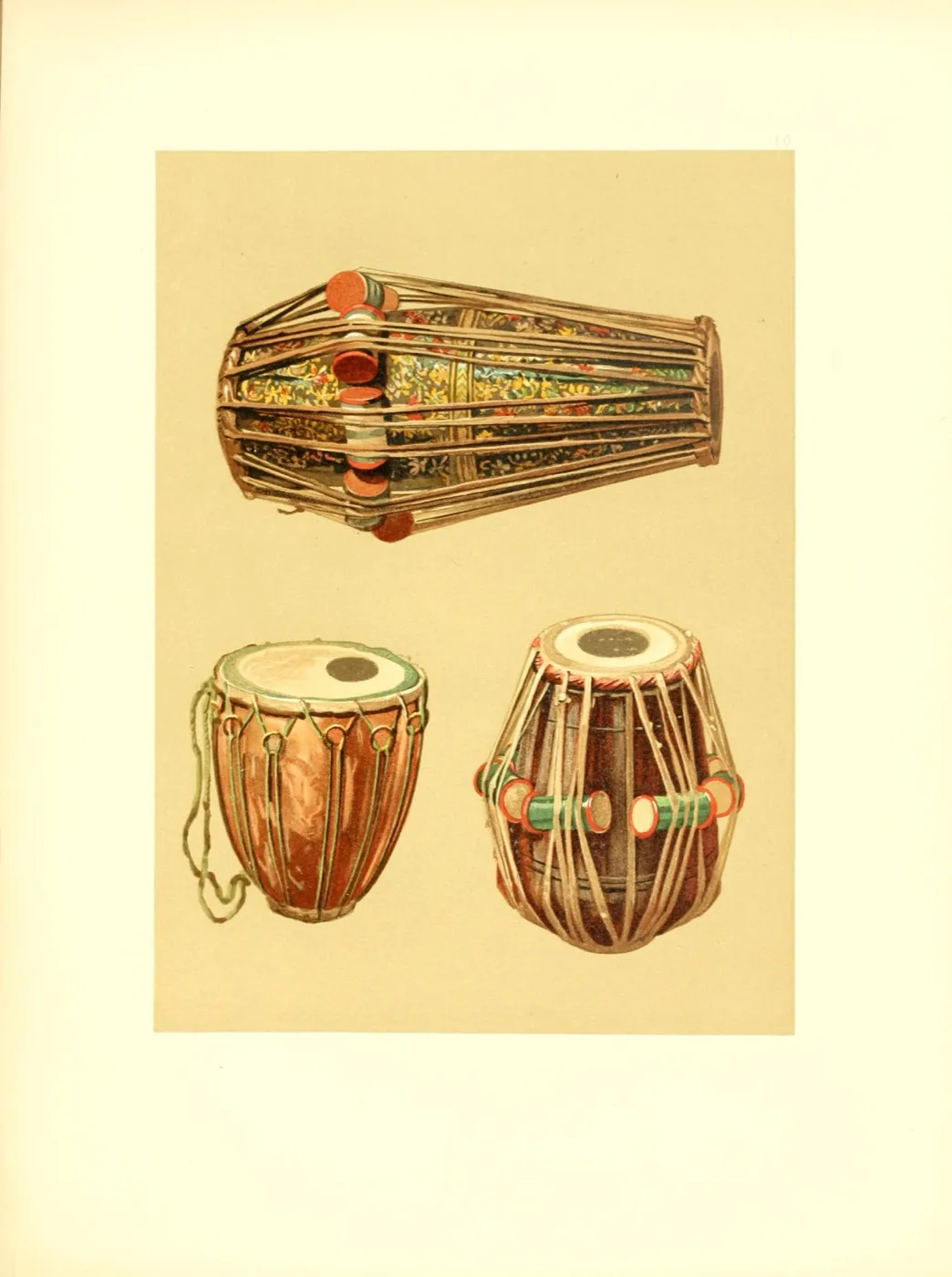
The dāyāñ looks like the treble end of a pakhāwaj stood upright. Curt Sachs, a historian of instruments, looked at its base in 1940 and wrote: “The manner in which the bottom is carved shows clearly that this instrument originally had a second skin, such as with the pakhavaja, which was given up when the drum came to be used in a vertical position.”30 Writers had been saying as much for a century. In 1834 the pair is “one instrument, divided from the middle”. In 1893 the Brussels museum, cataloguing instruments sent by a Calcutta musicologist, files both drums as “modifications du mridanga”. In 1914 the tabla is “like Pakhavaj equally divided into two parts”. In 1921, “one of them looks like a mridanga cut in half”.28311632
The bāyāñ is a bowl with one skin, the body of a kettledrum. The Brussels catalogue records it as terracotta, and a writer of 1891 calls the pair “small copper kettledrums”.3133 In 1834 the two drums even carry the naqqāra’s Persian names: the right “is used for the treble (Zeer) and the left for the bass (Bum)”.28 Stick playing has no ghissa, where the heel of the left hand presses and slides on the bāyāñ to bend its pitch.
The name is the Arabic ṭabl, written in Sanskrit letters by 1350 and heard by English ears as “tubla” by 1787.131424
So the pair draws on the pakhāwaj for the dāyāñ, on the naqqāra for the bāyāñ and the name, and on the old rules for how both are played. The dāyāñ is tuned to a svara. Both skins carry syāhī. The repertoire is taught by mouth, in bols. And the left and right parts, which the chapter gives to faces that may belong to one barrel or to separate drums, are now played on a drum each.
A recent thesis reads it differently, deriving the pair from the ḍhol and from Pashtun drumming, and putting the usual pakhāwaj account down to “elite bias”.34 The carved base of the dāyāñ and the long run of descriptions favour the pakhāwaj; the dance ensembles in which the pair first appears point toward the ḍhol. We keep the pakhāwaj and naqqāra account, with the note that the first players seem to have borrowed from every drum within reach.
One account says the early tabla’s bass drum was a wooden cylinder that “even used a temporary spot made of dough, as it still sometimes does in the Punjab”, later replaced by the clay bowl.29 The Punjab’s jōṛī is still played that way, with dough on the bass drum.35 Whether the jōṛī came before the tabla, grew up beside it, or is its first form is not settled.
Sudhār Khān, Amīr Khusrau and the split pakhāwaj
Each of the stories below first appears in print long after the earliest records of the pair.
| Story | First found in print | What it matches |
|---|---|---|
| The pair is one drum “divided from the middle” | 1834, as a description, with no inventor28 | How the dāyāñ is built |
| Sudhār Khān Ḍhāḍhī invented it | 1914: “Tubla is the happy invention of Sudhar Khan Dhari”16 | Delhi, and the Ḍhāḍhī line its players claim |
| Amīr Khusrau invented it | 1959, in an English article; also given as a saying in a Bengali handbook that cannot be dated safely3637 | The Persian name |
| Sudhār Khān lost a contest and smashed his pakhāwaj | 197338 | The dāyāñ’s pakhāwaj origin, told as an accident |
| The onlookers cried “tab bhī bolā”, still it speaks | Not dated. The one book read in full that tells it is from 2015, and it is plainly not the first39 | A pun that explains the name |
Amīr Khusrau died in 1325. A study of his life and works printed in 1935 lists the instruments named in his prose work on music, and no tabla is among them.40 The 1914 book that credits Sudhār Khān with the tabla credits Khusrau with the sitar instead.16 The claim that Khusrau made the tabla is first found in 1959, in an English article saying that he “replaced the old percussion instrument called the Mirdang, and introduced the Tabla”.36 A Bengali handbook gives the same idea, more cautiously, as a saying; its copies carry the dates 1952 and 1959, but the one we read cites a book of 1961, so it cannot be dated safely.37 More than six centuries lie between Khusrau’s death and the first printed claim.
The case for Sudhār Khān is better, though still not strong. The Delhi gharānā’s lineage begins with him, and a historian who recorded that lineage from its masters calls him “the first tabla player we know of”; whether he also made the instrument, the same historian says, “is just conjecture”.21 No source from his own century names him. The 2015 book cites an Urdu work of the 1870s for the story of the split pakhāwaj, and we have not been able to read that work. If it does tell the story, the contest and perhaps the pun move back about a century in the table, and the Khusrau row stays where it is.39
The contest story is often taught. It first appears in a government handbook of 1973, whose author tells it and then remarks: “Quite a convenient accident.”38
The late dates do not make the stories worthless, since each fits something the documents confirm: the split-drum story fits the dāyāñ’s pakhāwaj origin, the Khusrau story fits the Persian name, and the Sudhār Khān story fits Delhi and the Ḍhāḍhīs.
How the syāhī became permanent
The Nāṭyaśāstra used river earth or flour. Pakhāwaj players still put on fresh flour each time, while the tabla’s syāhī became permanent. The stages can be dated, with gaps.
In 1834 one end of the mridang is coated on the inside with “rosin, oil, &c.”28 Two drums that were in a London museum by 1890, catalogued separately, are each described with “a disc of black lac”.41 In 1914 the change is described outright:
“On the mrdanga the plaster is fresh made whenever the drum is used; on the tabla it is applied once for all, and has frequently been mixed with iron filings to add to the resonance, and is then black. It is called siyahi (blackness) ...”12
In a letter to Nature printed on 15 January 1920, C. V. Raman and Sivakali Kumar describe “a special type of musical drum which has long been known and used in India”, whose head carries a load “decreasing in superficial density from the centre outwards”, a “firmly adherent but flexible composition, in which the principal constituent is finely divided metallic iron”.42 An unloaded drumhead gives overtones that do not fit together. The loaded head gives a harmonic series, as a string does, which is why the dāyāñ gives a clear, tuned sur.
The letter does not name the drum. Raman’s full paper of 1934 does: “A modern variant of the Mridanga is known as the Thabla”, whose right-hand head “is very similar to that of the Mridanga”.43
The chapter had prescribed a load of dark earth to make a drum hold a note. Some eighteen centuries later Raman and Kumar, in Calcutta, described the same principle in a skin loaded with iron. Making the load permanent, and putting iron in it, was the work of drum makers of the last two or three centuries, and none of them is named.
One question is still open: nobody records when or why the bāyāñ’s syāhī moved off-centre. A colour plate of 1891 already shows it there, while the account of 1914 puts the off-centre patch on the right-hand drum, so the evidence is split.3312
The tabla today: shells, heads, tuning and electronics
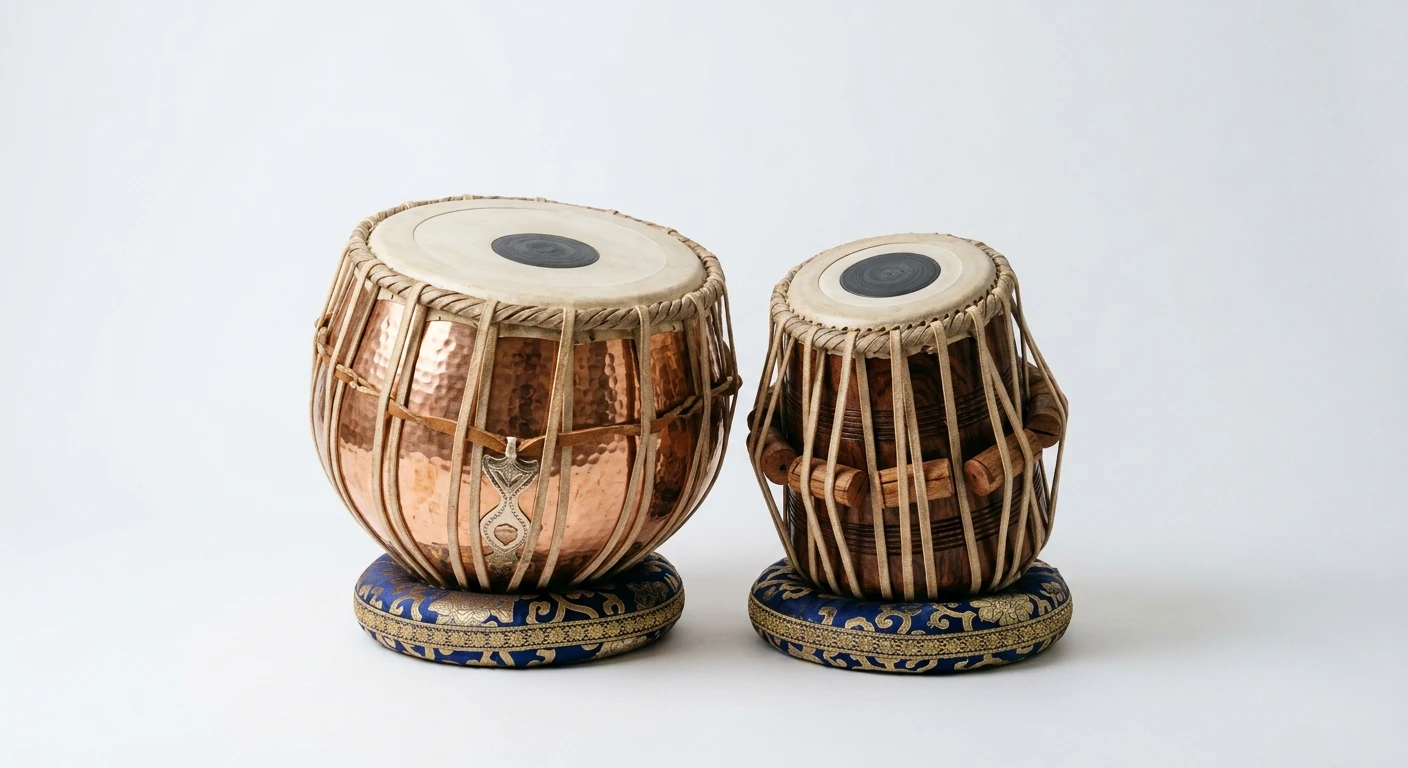
The bāyāñ never settled on one material. The Metropolitan Museum’s collection, formed by 1889, holds one late nineteenth-century bāyāñ of metal and another of wood; a pair made in the late twentieth century and given to the museum in 1986 is catalogued as “hide, wood, chromed copper”.44 Copper and brass bāyāñ are sold today; one seller describes its brass drums as “chrome polished”.45
The dāyāñ is still wood. In Amroha, in Uttar Pradesh, makers turn neem, sheesham or rosewood on a machine they call the badi kherat and load the head with a syāhī of “iron filings and gum”. One family there has made tabla since 1950, and its makers say that seasoned wood is getting harder to find.46
The earliest skinless tabla we can date is K. Varadarangan’s, which appeared in March 2018 in two models, one for pitches C to D and one for D to E.47 He had made a mridangam without animal skin first. For the loaded patch on both drums he used “a bond of black rubber and polyester film”,48 fixed to the head “through a chemical process without the use of adhesives”.47 Varadarangan names the work of C. V. Raman and B. S. Ramakrishna at the Indian Institute of Science as the basis of the design.48 The skin is gone, but the head is still loaded at the centre, because the load is what gives the harmonic sur.
Bolts have reached skin tabla as well. One maker sells pairs with sixteen bolts and a tuning hammer in place of straps and gaṭṭās, “easy to tune & easy to replace the new skin”, in its own words.45 We found no independent source that says when the first bolt-tuned tabla was made.
One newer head turns the syāhī over. In 2021 a tabla player’s blog described an “ulta syahi” trend: the black patch is put “on the underside of the skin so that it is not exposed”, which keeps sweat from lifting it. The writer said it had been around for a while but had few takers.49 A maker sells such a pair as a “reverse syahi tabla” and calls it a world first; the claim is the maker’s own.50 The idea is older than either: in 1834 one end of the mridang was already coated on the inside.28
Since the 1980s the tabla has also been built without skins at all. Radel, an Indian maker, dates its first electronic tabla, the Taalmala, to 1987, when it accompanied a flute recital; the date is the maker’s own.51 Boxes of this kind are not struck: they play ṭhekā for practice. In 2002 Ajay Kapur and three colleagues presented a tabla that is struck, a controller with pads on which the heel of the hand can bend the bāyāñ’s pitch, as it does on the skin.52 In March 2024 Keda Music launched the Tabla Touch in Mumbai, which it calls “the world’s first playable electronic tabla”; the claim is the maker’s own.53
On the bolted and electronic drums the pitch is set with a spanner or a control instead of with gaṭṭās and gajrā. They are still played in bols, with separate parts for the two hands, on a tuned note.
Limitations. Sources here are ranked by weight: dated text, then dated picture, then dated object, then story, each story dated by its first appearance in print. Joining the Nāṭyaśāstra to the modern pair is our own reading, not a scholar’s. We could not read a 1974 thesis behind the usual date of 1725–1750, an Urdu book of the 1870s cited for the split-pakhāwaj story, or the 1762 sketch said to show two tablas; any of them could move a date.
Questions people ask
Who invented the tabla?
No one is recorded as inventing it. The pair appears in the record in the middle of the eighteenth century. Sudhār Khān of Delhi is the first player his gharānā’s lineage remembers; the earliest book we have found that calls him the inventor was printed in 1914.
Is the tabla in the Nāṭyaśāstra?
The Nāṭyaśāstra describes a set of barrel drums. Its drum chapter sets out four rules the tabla follows: skins tuned to a svara, skins loaded with a dark paste, strokes spoken as syllables, and separate parts for the left and right hands.
Did Amīr Khusrau invent the tabla?
There is no evidence that he did. He died in 1325; the claim is first found in print in 1959, and the list of instruments drawn from his own prose has no tabla in it.
Is the tabla Indian or Arabic?
The word comes from Arabic ṭabl, a drum, and was in India by 1350. On the usual account, the instrument was made in north India in the eighteenth century, from the treble head of the pakhāwaj and the bowl of the naqqāra; one recent study looks instead to the ḍhol.
How old is the tabla?
As a pair of drums, under three hundred years on the evidence we have. The practice it carries, loading a drum skin with paste to tune it, is written down in a text that existed by about the second century.
For the parts of each drum, see What is tabla? For looking after the syahi on your own drums, see the tabla care guide.
Sources
- Bharata. The Nāṭyaśāstra, trans. Manomohan Ghosh, vol. 2. Calcutta: Asiatic Society, 1961. Ch. XXXIII, “On Covered Instruments”, vv. 5–10, 25–26, 40–43, 102–103, 109, 111, 114–116, 240, 243, 263–264, 272–279, 301, with notes 5, 25, 27, 42–46. Read at https://www.wisdomlib.org/hinduism/book/the-natyashastra/d/doc210231.html. Accessed 25 November 2026.
- Manomohan Ghosh, trans. The Nāṭyaśāstra, vol. 1. Calcutta: Royal Asiatic Society of Bengal, 1950. Introduction, part 8, “The Date of the Nāṭyaśāstra”.
- Natalia Lidova. “The Nāṭyaśāstra: the Origin of the Ancient Indian Poetics.” Cracow Indological Studies 14 (2012): 61–85.
- Bharata. Nāṭyaśāstra, Sanskrit text ed. Manomohan Ghosh, vol. 2 (chs 28–36). Calcutta: Asiatic Society, 1956. Ch. 33, vv. 5–11, 40–42 and prose following, 103, 109, 111, 114–116, 243, pp. 146–161, 179. https://archive.org/details/TxtSktNATyaSAstraMMGhoshTextV2Ch28to3619560118a. Accessed 25 November 2026.
- Monier Monier-Williams. A Sanskrit-English Dictionary. Oxford: Clarendon Press, 1899. s.vv. “ūrdhvaka”, “ūrdhva”, p. 222; “harītakī”, p. 1292. https://www.sanskrit-lexicon.uni-koeln.de/scans/MWScan/2020/web/webtc/getword.php?key=Urdhvaka&filter=roman&transLit=hk. Accessed 25 November 2026.
- B. Chaitanya Deva. Musical Instruments of India: Their History and Development. Calcutta: Firma KLM, 1978. pp. 87–89.
- Sirirat Prapatthong. “Thai Musical Instruments Based on Archaeological and Other Related Sources from the Ancient to Medieval Period in Indian Context.” PhD thesis, Maharaja Sayajirao University of Baroda, 1998. pp. 173–175, 178.
- Pierre Rambach and Vitold de Golish. The Golden Age of Indian Art, Vth–XIIIth Century. Bombay: D. B. Taraporevala, 1955. p. 16 and plate 77. https://archive.org/details/in.ernet.dli.2015.128579. Accessed 24 November 2026.
- Abhinavagupta. Abhinavabhāratī on Nāṭyaśāstra 34.9–13, in the Baroda edition (note 5), p. 405.
- Śārṅgadeva. Saṅgītaratnākara, with the commentaries of Kallinātha and Siṃhabhūpāla, ed. S. Subrahmanya Sastri, vol. 3. Madras: Adyar Library, 1951. Ch. 6, vv. 12–14, p. 230; vv. 1154–1156, p. 485.
- Abū’l-Fażl. The Ain i Akbari, vol. 3, trans. H. S. Jarrett. Calcutta: Asiatic Society of Bengal, 1894. pp. 255–257. https://archive.org/details/in.ernet.dli.2015.32529. Accessed 25 November 2026.
- A. H. Fox Strangways. The Music of Hindostan. Oxford: Clarendon Press, 1914. p. 83; pp. 226–228 and plate 12.
- John T. Platts. A Dictionary of Urdu, Classical Hindi, and English. London: W. H. Allen, 1884. p. 751.
- Sudhākalaśa. The Saṅgītopaniṣat-sāroddhāraḥ: A Fourteenth-century Text on Music from Western India, ed. and trans. Allyn Miner. New Delhi: Indira Gandhi National Centre for the Arts and Motilal Banarsidass, 1998. Ch. 4, v. 93, pp. 132–133.
- Abū’l-Fażl. The Ain i Akbari, vol. 1, trans. H. Blochmann. Calcutta: Asiatic Society of Bengal, 1873. Ā’īn 19, pp. 50–51.
- Atiya Begum Fyzee-Rahamin. Indian Music. London: William Marchant, 1914. pp. 72, 74, 86–87. https://archive.org/details/cu31924022492338. Accessed 25 November 2026.
- Jaffur Shurreef. Qanoon-e-Islam, or the Customs of the Moosulmans of India, trans. G. A. Herklots. London: Parbury, Allen, 1832. Appendix, pp. xlix–l.
- Ras Baras. Shams al-Aṣvāt: The Sun of Songs, ed. and trans. Mehrdad Fallahzadeh and Mahmoud Hassanabadi. Uppsala: Acta Universitatis Upsaliensis, 2012. p. 127.
- Dargah Quli Khan. Muraqqa’-e-Dehli: The Mughal Capital in Muhammad Shah’s Time, trans. Chander Shekhar and Shama Mitra Chenoy. Delhi: Deputy Publication, 1989. Foreword and pp. 92–95.
- Joep Bor. “The Voice of the Sarangi: An Illustrated History of Bowing in India.” Quarterly Journal of the National Centre for the Performing Arts 15–16, nos. 3, 4 and 1 (September 1986 to March 1987). Second-cover caption, and section 4.4, pp. 57–62.
- James Kippen. “History and genealogy of the Delhi tabla gharana.” Post to the newsgroup rec.music.indian.classical, 11 August 1993. https://groups.google.com/g/rec.music.indian.classical/c/CGxFCnKrDgQ. Accessed 25 November 2026.
- Victoria and Albert Museum, London. Raja Balwant Singh watching a dancer, attributed to Nainsukh, about 1750. Museum number IS.24-1974. Collection record. https://collections.vam.ac.uk/item/O96492/. Accessed 25 November 2026.
- W. G. Archer. Indian Paintings from the Punjab Hills, vol. 1. London: Sotheby Parke Bernet, 1973. “Jammu”, no. 55, p. 208.
- John Gilchrist. A Dictionary, English and Hindoostanee, part 1. Calcutta: Stuart and Cooper, 1787. s.v. “Drum”, p. 275.
- Balthazar Solvyns. A Catalogue of 250 Coloured Etchings; Descriptive of the Manners, Customs, Character, Dress, and Religious Ceremonies of the Hindoos. Calcutta: Mirror Press, 1799. Section XI, no. 17.
- Solvyns Etchings Online. University of Texas at Austin. Plate “A Tubla”, low-resolution image. Accessed 24 November 2026.
- Thomas Duer Broughton. Letters Written in a Mahratta Camp during the Year 1809. London: John Murray, 1813. Letter XVI, pp. 190–191.
- N. Augustus Willard. A Treatise on the Music of Hindoostan. Calcutta: Baptist Mission Press, 1834. pp. 79–81, and glossary, s.vv. “Drums”, “Tubla”.
- James Kippen. “Folk Grooves and Tabla Tāl-s.” ECHO: A Music-Centered Journal 3, no. 1 (2001). Web article, unpaginated. https://echo.humspace.ucla.edu/?p=567. Accessed 25 November 2026.
- Curt Sachs. The History of Musical Instruments. New York: W. W. Norton, 1940. pp. 229–230.
- Victor-Charles Mahillon. Catalogue descriptif et analytique du Musée instrumental du Conservatoire royal de musique de Bruxelles, vol. 1, 2nd ed. Ghent: Ad. Hoste, 1893. pp. 91, 104–105.
- Herbert A. Popley. The Music of India. Calcutta: Association Press, 1921. p. 121.
- C. R. Day. The Music and Musical Instruments of Southern India and the Deccan. London: Novello, Ewer, 1891. pp. 137–138 and plate X.
- Michael P. Lindsey. “Melodies for Drums: Creativity and Emotion in South Asian Ṭhekā Drumming.” PhD diss., University of California, Santa Cruz, 2020. pp. 201–222; “elite bias” is on p. 213.
- Haruo Inoue. “Entangled Drum Histories: Friction, Embodiment, and the Making of Religious Sound in North India.” Asian Review 39, no. 1 (2026): 59–83.
- Shahid Ahmad Dehlavi. “Tradition and Change in Indo-Pakistani Classical Music.” Journal of the Siam Society 47, no. 2 (1959): 167–177, at p. 170. https://thesiamsociety.org/wp-content/uploads/1959/03/JSS_047_2c_ShahidAhmadDehlavi_TraditionAndChangeInIndoPakistaniMusic.pdf. Accessed 25 November 2026.
- Shambhunath Ghosh. Tablar Itibritta. Calcutta: Gandhar Prakashani. One scanned copy gives the first edition as 1952, another as 1959; the text read cites a book printed in 1961. pp. 6–7, 11.
- B. Chaitanya Deva. An Introduction to Indian Music. New Delhi: Publications Division, Ministry of Information and Broadcasting, 1973. p. 54.
- Vijay Shankar Mishra. Art and Science of Playing Tabla. New Delhi: Publications Division, 2015. pp. 1–2.
- Mohammad Wahid Mirza. The Life and Works of Amir Khusrau. Calcutta: Baptist Mission Press for the University of the Panjab, 1935. pp. 218–219, n. 7.
- Victoria and Albert Museum, London. Museum numbers IS.70-1890 and IS.69:1-1890. Collection records. https://collections.vam.ac.uk/item/O474980; https://collections.vam.ac.uk/item/O474981. Accessed 25 November 2026.
- C. V. Raman and Sivakali Kumar. “Musical Drums with Harmonic Overtones.” Nature 104 (1920): 500. https://doi.org/10.1038/104500a0.
- C. V. Raman. “The Indian Musical Drums.” Proceedings of the Indian Academy of Sciences, Section A 1, no. 3 (1934): 179–188. https://doi.org/10.1007/BF03035705.
- The Metropolitan Museum of Art, New York. Bāyā, late nineteenth century, 89.4.150 (metal, skin); Bāyā, late nineteenth century, 89.4.167 (wood, skin); Tabla and Bhaya, late twentieth century, 1986.467.79a, b (hide, wood, chromed copper). Collection records, read through the museum’s open-access API. https://www.metmuseum.org/art/collection/search/500732; https://www.metmuseum.org/art/collection/search/500713; https://www.metmuseum.org/art/collection/search/504453. Accessed 27 November 2026.
- Kaayna Musicals. “Tabla Drum Set – 16 Bolt Tuned, 2.5 Kg Brass Bayan, Chrome Finish, Sheesham Wood Dayan.” Product page, n.d. https://kaaynamusicals.com/product/tabla-drum-set-16-bolt-tuned-2-5-kg-brass-bayan-chrome-finish-sheesham-wood-dayan-hand-made-drum-skin-easy-to-tune-or-replace-the-skin-tuning-hammer-gig-bag-cushion-cover-for-bhajan-kirtan/. Accessed 27 November 2026. A maker cited for its own product.
- Tatheer Zehra. “How Tablas Are Made in Amroha: A Step-by-Step Photo Story.” The Better India, 11 August 2025. https://thebetterindia.com/484991/amroha-tabla-making-steps-workshop-artisans-photo-story-traditional-craft. Accessed 27 November 2026.
- Aparna Karthik. “Go Vegan, Musically.” Deccan Herald, 18 November 2018. https://www.deccanherald.com/spectrum/go-vegan-musically-703484.html. Accessed 27 November 2026.
- Ram Rakshith V. “Innovator Makes Mridangam, Tabla without Animal Skin.” Deccan Herald, 23 July 2021. https://www.deccanherald.com/entertainment/innovator-makes-mridangam-tabla-without-animal-skin-1012182.html. Accessed 27 November 2026.
- taalmagic (blog of a tabla player). “Sunday Musings – What Is Your Take on the ‘Ulta Syahi’ Trend – Classy or Creepy?” 19 June 2021. https://taalmagic.blogspot.com/2021/06/sunday-musings-what-is-your-take-on.html. Accessed 27 November 2026.
- Qasim Tabla Maker. “Reverse Syahi Tabla Pair.” Product page, 9 July 2022. https://qasimtablamaker.com/product/reverse-syahi-tabla-pair/. Accessed 27 November 2026. A maker cited for its own product and its own claim.
- Radel Electronics. “About us.” Company timeline, n.d. https://www.radel.in/about-us/. Accessed 25 November 2026. A maker cited for its own product.
- Ajay Kapur, Georg Essl, Philip Davidson and Perry R. Cook. “The Electronic Tabla Controller.” In Proceedings of the International Conference on New Interfaces for Musical Expression, 108–112. Dublin, 2002. https://doi.org/10.5281/zenodo.1176434.
- Keda Music. “Electronic Tabla.” Product page, n.d. https://keda.co.uk/electronic-tabla/. Accessed 24 November 2026. A maker cited for its own product and its own claim. The launch is reported in “World’s First Electronic Tabla Launches in Mumbai, Tabla Touch.” Mixmag, 22 March 2024. https://mixmag.net/read/worlds-first-electronic-tabla-launches-mumbai-tabla-touch-tech. Accessed 25 November 2026.