
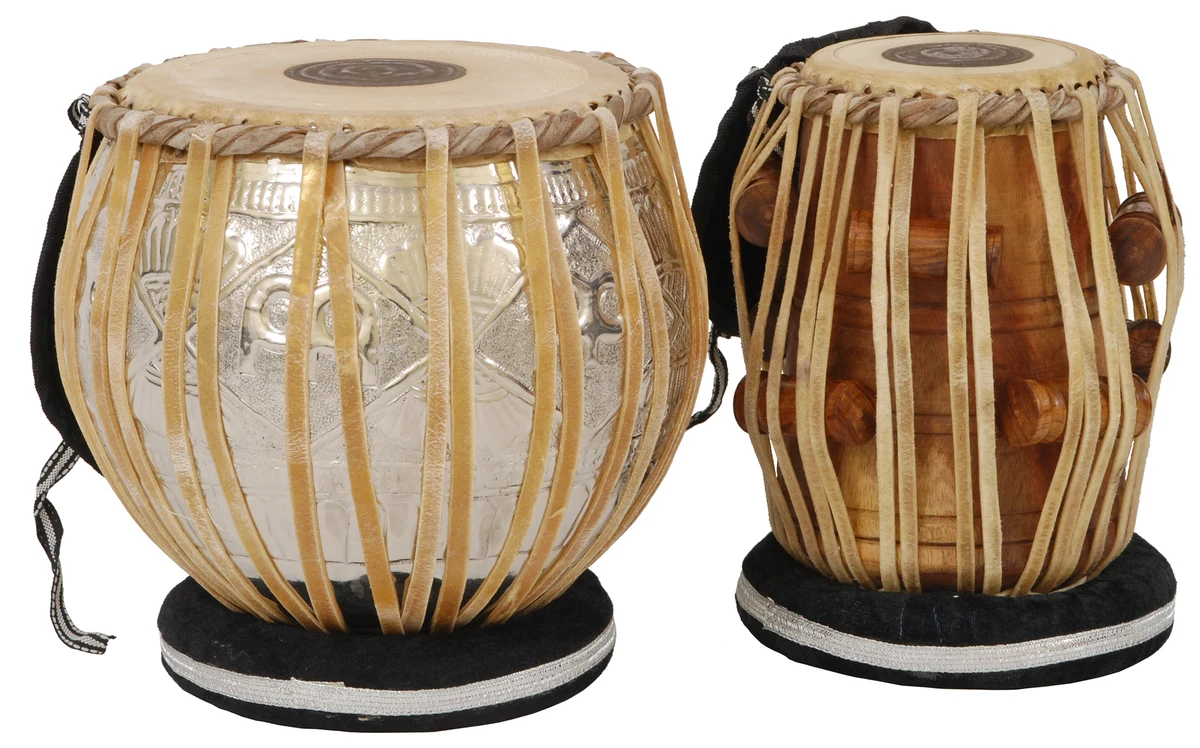

Parts of a tabla
The dayan usually has a wooden body. Its clear, high note is often tuned to the tonic, called Sa. The bowl-shaped bayan often has a metal body. As an open bass stroke rings, the player can press the heel of the hand into the skin to bend its pitch. Both heads carry a dark patch called the syahi. On the bayan it usually sits off centre, leaving room for the heel. Allen Roda’s account for The Met
- Pudi
- The complete drumhead stretched over the open end of the shell.
- Syahi
- The black patch on the head. It adds weight to the skin and shapes how the drum rings.
- Maidan
- The exposed playing skin between the black patch and the outer ring.
- Kinar
- The outer ring of playing skin. Some teachers call it the chati.
- Gajra
- The thick woven rim around the drumhead.
- Baddhi
- The straps that run down the sides and hold the head under tension.
- Gatte
- The wooden tuning blocks under the straps on a traditional dayan.
- Gudri
- The padded ring that supports each drum.
See the labelled diagram for the location of each part. David Courtney’s anatomy and maintenance guide
Hear the two drums
Listen for the bright, pitched ring of the smaller drum.
Listen for the low, round bass note of the larger drum.
Hear how the two drums work together in The Met’s demonstration by Samir Chatterjee, with Ramesh Misra on sarangi and Benjamin Stewart on tambura. Listen at The Met
How tabla is played
Players use the fingers and palms to make ringing and damped strokes. They learn spoken syllables called bols for the strokes and phrases. Saying the bols lets a player learn and share a pattern before playing it. Rohit M A and Preeti Rao’s study of bol recitation
In Hindustani music, tabla accompanies singers, instrumentalists, and Kathak dancers. A player can mark the rhythmic cycle with a repeating pattern called a theka. In a tabla solo, the drummer takes the lead and a repeating melody called a lehra can mark the cycle. Follow one 16-beat pattern in the Teentaal guide.
How to start playing tabla
- Find a teacher. In traditional settings tabla is learnt entirely by ear. The teacher says or plays a phrase, and the student repeats it aloud and on the drums. That teaching is called taleem, and practising alone between lessons is riyaz. The best way to find a teacher is to ask a musician friend, then meet the teacher in person. If you know no musicians, search Google Maps for “tabla classes” or “Indian music school” near you and read the reviews. Search Instagram and YouTube for “tabla teacher” with the name of your city, and listen to how the teacher and their students play. You can also ask at a cultural centre, a temple or gurdwara, or a university music department. Many teachers give live lessons online. When you meet a teacher, ask who they learnt from and which gharana they teach, and ask for a trial lesson.
- Get a tabla pair. The buying guide lists what to check before you pay.
- Sit so your shoulders stay loose. Sit cross-legged, kneel, or stand with the tabla on a table. Keep your shoulders relaxed and level, and your elbows off your legs and the drums. Set the drums up for your dominant hand, with the bayan standing straight up and the dayan tilted slightly away from you.
- Say each stroke before you play it. Music Mark’s curriculum begins with the closed strokes it spells Khe (Ka in our bols chart) and Tite. It then adds the open strokes Na and Ge, and later Dha, which is Ge and Na played together.
- Keep time with your hands, then with a lehra. Clap and wave the divisions of the cycle. The curriculum suggests starting exercises at 60 beats per minute with a metronome or a lehra. To try it, follow the Teentaal guide and play along in the Lehra Player.